Tuesday, June 13, 2006


Dr. Strangelove in the war room Posted by Picasa
Nuclear Lessons: The Sanity Clause

There were many influential figures in the history of nuclear weapons, but perhaps the most important didn’t actually exist: his name was Doctor Strangelove.

Strangelove came to symbolize the essential madness of nuclear war. In a previous essay, I wrote about how nuclear war was averted through a common global sense that it was suicidal and immoral. But there was another element to the consensus: that nuclear war was evidence of insanity. Not just madness in the loose sense, but in the sense of mental derangement. The view that came to prevail was that only a species that had gone mad would engage in a war that would destroy itself.

This was one of the psychological aspects of the Cold War nuclear stand-off—probably the healthiest, in that it was a factor in preventing nuclear war. But there were other psychological aspects that were less amusing or healthy, like helpless fear and anxiety, and dangerous projections and denial that threatened to provoke rather than restrain nuclear war. Now, in facing the prospect of a different kind of nuclear war or even the other potential catastrophes of our time, we are still haunted by these psychological spectres.


text continues after photos

Dr. Strangekahn Posted by Picasa
Invented for a 1964 movie of that title, Dr. Strangelove was likely based on several men, including Nazi-turned-U.S. rocket scientist Werner von Braun and geopolitical strategist Henry Kissinger, but probably primarily on nuclear scientist Edward Teller and nuclear war futurist Herman Kahn. Teller zealously promoted the H-Bomb and the arms race, as well as grandiose schemes such as using atomic bomb explosions as excavation tools. Kahn…well, Kahn is another story.

Once it became likely that the next war could be an atomic one, the U.S. military wanted to know what to expect. A project within the Douglas Aircraft Company which soon spun off to become the Rand Corporation, and one of its guiding lights was Herman Kahn. Kahn and Rand made some lasting contributions to how we think about the future. Together with scientists at M.I.T. and elsewhere, they were among the pioneers of systems dynamics. Kahn developed and popularized the idea of developing “scenarios” to project a combination of chosen factors into a story of future happenings. Out of this emerged a technique common to all kinds of “futurists,” and computer “war games,” the basis for a lot of electronic gaming today. And we talk about “scenarios” all the time now, though before Kahn it was specialized theatrical term.

But in “Thinking the Unthinkable” and other works on nuclear war, Kahn was also the inventor or at least the popularizer of such terms as "deterrence" and "throw-weight" or the ghastly jargon of "megatons," and "megadeaths." Kahn insisted on the "rationality of irrationality" in studying nuclear war, and he advocated the Cold War situation which came to pass: two sides armed with the “overkill” capacity to destroy each other and humankind several times over, and with the technology to respond to an attack (or a presumed attack) with enough nuclear weapons to destroy its destroyers. This would be the basis of deterrence. He called this doctrine Mutually Assured Destruction. He used its acronym: MAD.

Doctor Strangelove was demonstrably mad in a characteristic nuclear age way. He spoke very rationally and intelligently about mass murder and global suicide. As played brilliantly by Peter Sellers, he was confused in his allegiances—was he serving democracy, or Hitler? Even his body was split, with a “paralyzed” arm that when he was about to commit the ultimate insanity, tried to choke him.

He was not the only crazy character. There was George C. Scott as a combination of several military leaders, who talked of millions of deaths as “getting our hair mussed,” and carried around a folder that said “the world in megadeaths.” But the moviemakers had trouble making the movie crazier than reality. General Jack D. Ripper (who started nuclear war to protect his “precious bodily fluids”) was based on a general whose real name was General Powers. He once said that if there are three people left alive after a nuclear war and two are American, it means we won.

In fact, the moviemakers had intended to make a serious drama, but the more they researched the subject the more they became convinced that it was all so crazy that the appropriate tone was as a “nightmare comedy.” The mood of the movie is reminiscent of the Marx Brothers, particularly their satire on war, “Duck Soup.” In another movie, Groucho and Chico negotiate a contract. Chico rejects every clause including the last one, the sanity clause. He says he won’t be fooled, because “there is no sanity clause.” That pretty much is the message of “Doctor Strangelove.”

"I saw the best minds of my generation
destroyed by madness"--Allen Ginsberg's "Howl." Posted by Picasa
Excavating the Madness

The madness of nuclear war was not always apparent to the public as a whole, or at least not articulated in that way. The first reactions to Hiroshima were of horror, and the need to control nuclear weapons. But once the arms race began, there was considerable pressure to support the U.S. nuclear weapons program.

The U.S. government worried about how the public was dealing psychologically with the atomic age. They waited for psychological studies, but none emerged, because the public didn’t seem to be feeling anything. Eventually, the government quietly sponsored research into why the public wasn't reacting. The theories ranged from "cognitive dissonance" to a kind of apathy later identified as "learned helplessness," to the simple but powerful psychological defense mechanism known as denial.

Denial was undeniably the national pastime of the 1950s, encouraged by the surface sunniness of suburbia and the patriotic repression of McCarthyism. But what ordinary people faced was that their ordinary life could be transformed in a split second into hellfire. No one could ever know how much the Bomb contributed to neuroses and psychoses, alcoholism and drug addiction, infidelity, domestic violence, and divorce, or to depressions that could be a crippling sense of pointlessness, or a lower-intensity, underlying sense of futility. But eventually there was public evidence of how the Bomb changed the psychological state of the times.

The pressure of MADness fueled an age of black humor and absurdism. Satire blossomed in the 1960s, with “Beyond the Fringe,” “That Was the Week That Was,” Firesign Theatre and edgier standup comedy by Lenny Bruce, Mort Sahl, Shelley Berman and others.

There were also serious explorations of just how insane this society might be, by Eric Fromm (The Sane Society), Lewis Mumford (In the Name of Sanity) and others. Beat poets, absurdist playwrights and novelists explored similar themes.

George C. Scott in Dr. Strangelove Posted by Picasa
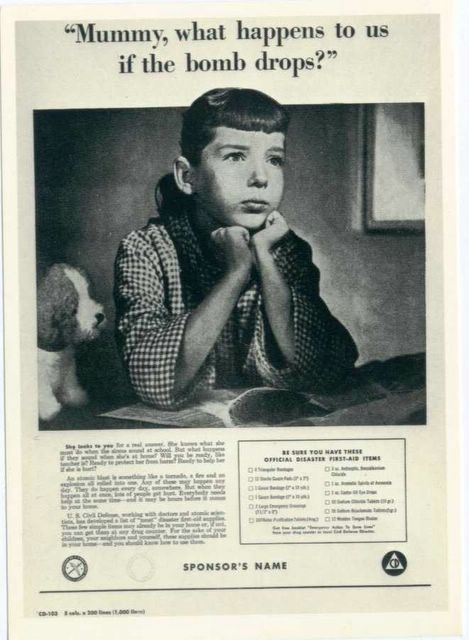
By the early 60s, the madness of nuclear war was being expressed and reinforced in popular culture by jokes and cartoons which emphasized the absurdity, and by novels, movies and television dramas which emphasized the horror. Though the horror and absurdity blended even in daily life (ask a Boomer about “Duck & Cover”), the two weren’t brought together and expressed until Stanley Kubrick’s “Dr. Strangelove.”

Though it was controversial at the time, “Dr. Strangelove” became at least as important as John Hershey’s book, “Hiroshima,” the Stanley Kramer film, “On the Beach,” and much later, Nicholas Meyer’s TV film, “The Day After,” in both forming and expressing common responses and beliefs about nuclear war. “Dr. Strangelove” expressed the sane view that nuclear war was insane. That deep psychological consensus, in my view, was a major factor in preventing anyone from starting a nuclear war.

Since the Berlin Wall fell, the constant psychological as well as moral presence of nuclear war has faded. New generations didn’t live through that time, even though the threat of accidental nuclear war is as real today as it was then, and we have plenty of evidence that the potential for that kind of madness exists in our government and military.

My previous essays on nuclear war, especially relating to the possible nuclear attack on Iraq, sought to bring into light some of the lessons of those years: that nuclear weapons are not just bigger bombs, but unleash destruction that is different in kind as well as scale, especially through the long-term and potentially widespread effects of radiation. That because of the Bomb’s history, and the sense of immorality attached to their use, nuclear weapons are considered in a special category around the world, and the next use of them in war will likely bring immense geopolitical consequences.

To these I add the assertion that nuclear war was averted without either a coercive or cooperative world government or authority, largely because of a shared sense that however rational scientists, political and military leaders pretend it is, nuclear war is insane. We know they are all Dr. Strangelove. We need to remind ourselves of that.

There is another pertinent psychological implication—the danger that, from the power-mad leaders to the fear and despair of ordinary people, the use of nuclear weapons can itself drive a society or perhaps all of humankind insane.

Some of the responses to my previous essays expressed fears and anxieties that are very similar to those experienced earlier in the atomic age. The sense of helplessness feeds these fears. So in the remainder of this essay, I want to suggest two strategies for dealing with the psychological impact of nuclear weapons.

Carl Jung Posted by Picasa
Two Strategies

In 1957, an aged Carl Jung was interviewed extensively for an educational film made by a Texas scholar. Probably the most quoted lines from those interviews are these:

“Nowadays particularly, the world hangs on a thin thread. Assume that certain fellow in Moscow lose their nerve or their common sense for a bit; then the whole world is in violent flames.” After pointing out that there is no such thing in nature as an H-bomb, he continues: “…that is all man’s doing. We are the great danger. The psyche is the great danger. What if something goes wrong with the psyche?”

But Jung didn’t mean just about the psyche of leaders (talking to a U.S. interviewer, he was gracious enough not to mention certain fellows in Washington as well as Moscow.) He meant everyone.

“And so it is demonstrated to us in our days what the power of psyche is, how important it is to know something about it. But we know nothing about it. Nobody would give credit to the idea that the psychical processes of the ordinary man have any importance whatever.”

This is just as true today. We know relatively nothing about the human psyche, and we talk on the level of politics, policy, government, business, society as if the human psyche doesn’t exist or is of no importance—as if the field of politics is governed by its own rules only, and is entirely rational and conscious.

But when something like the prospect of nuclear war or the Climate Crisis awakens fears and anxieties in us that are hard to consciously control, or when we plunge into depression because Karl Rove is getting away with it, the psyche asserts itself in a way that we can see.

But even the simplest conceptual tools developed by Jung and others would be immensely useful in both analyzing our situation and in dealing with our own responses. Simply admitting that a phenomenon called the unconscious exists, and learning how powerful it is, how its manifestations mask themselves as rational products of consciousness, would be a tremendous start.

The concept of denial has entered the lexicon. But of at least equal importance is the concept of projection, of seeing in others the qualities and behavior you fear in yourself.

We know nothing about it, was Jung’s cry of pain at the end of a long career. Basic psychological concepts are essential tools of peace, globally and personally. Some of the understanding that eludes us when we don’t use them is possible when we do.

We can learn something about the psyche as a strategy—about our own and perhaps the psychological concepts that applied to the public discourse could help to change things for the better.

F. Scott Fitzgerald Posted by Picasa
This is a general strategy. There is a more specific one that applies to many other issues and our general situation. It has to do with dealing with fear, despair and the sense of futility.

One reason we feel so vulnerable is inherent in our “either/or” way of thinking, an essential element in the 5,000 year history of what we call civilization. It may come as quite a shock to us that so-called primitive humans as far back as the Pleistocene had a more complex response to their reality.

For example, as they felt very close to animals, consciously learned from them, and considered them the embodiment of essential spirits. Yet they hunted and killed them. Scholars of the period such as Paul Shepard believe this deeply troubled them, but they developed a more complex way of seeing reality, which to our thinking would be paradoxical, though to theirs was a kind of natural spirituality.

Dealing with contradictions in our own lives has been a challenge for a long time, and going on living when great catastrophe can strike at any time is a challenge of our time.

In his novel, The Time Machine, H.G. Wells created a time Traveller who sees humanity as we know it end in the future, and he sees the earth eventually become lifeless. How can anyone avoid despair with such knowledge?

“I grieved to think how brief the dream of the human intellect had been," the Traveller recalled. " It had committed suicide." In an epilogue, the Traveller’s best friend acknowledges that the Traveller "thought but cheerlessly of the Advancement of Mankind and saw in the growing pile of civilization only a foolish heaping that must inevitably fall back upon and destroy its makers in the end."

The friend’s conclusion is a single sentence that also sums up Wells’ lifelong faith: “If that is so, it remains for us to live as though it were not so."

This is not acceptance of evil in our time, or complacency or denial, but acceptance of the rightness of our struggles and our lives regardless of the ultimate outcome. It’s summarized also in a quote from F. Scott Fitzgerald, who mentions Wells several time in his first novel.

"…the test of a first-rate intelligence is the ability to hold two opposed ideas in the mind at the same time, and still retain the ability to function.”

That’s the part of his statement most often quoted, usually with reference to Keats’ theory of ‘negative capability.” But Fitzgerald went on, in a more Wellsian vein, and in a way that speaks most directly to us today:

“One should, for example, be able to see that things are hopeless and yet be determined to make them otherwise."

Monday, June 12, 2006


Jerome Kagan Posted by Picasa

Elders

To Make A Better World

This spring , Yale University Press has published summary works by two distinguished Americans in different fields that address attitudes and actions forming our common world : the famed psychologist and writer Jerome Kagan, and the veteran expert on public opinion and social values research, Daniel Yankelovich. Both books are of special interest to their disciplines but in this era of boundlessly bounded expertise, both are of immense value to a wider readership. This relevance reflects the careers and lifelong concerns of both authors to relate their work to the general welfare, and to the major public dialogues of their times.

continued here at Books In Heat.

Tuesday, May 23, 2006


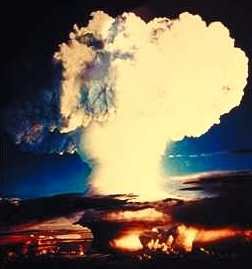
Hydrogen bomb explosion. Absense of international control
led to a nuclear arms race, but the world still didn't blow itself up.
Why not? Posted by Picasa
Nuking Iran II: The Geopolitics of American Suicide

In an interview with CNN, Israeli Prime Minister Ehud Olmert said that Iran is months away from developing a nuclear weapon, not the five to ten years that most experts estimate. He said that while Israel is not comtemplating unilateral military action, he “expressed confidence” that President Bush “will lead other nations in taking the necessary measures to stop Iran from becoming a nuclear power.”

We don’t know if Olmert urged military action when he met with Bush Tuesday, or even if this is a message already coordinated with the White House, but the spectre of U.S. bombing of Iran in the near future must again be faced.

Presumably, planners are anticipating possible military and geopolitical responses to bombing targets in Iraq. But is anyone thinking about the geopolitical consequences of one possible aspect of such an attack: the use of nuclear weapons?

Because this act is in itself highly consequential. If it were to happen, it could well mark the beginning of the end of the U.S. as a world power, and certainly change how this country is viewed in the world, forever. The reasons are found in history, and in the intensity of the response to nuclear weapons.

In a previous essay, I wrote about the realities of radiation, and the policy of secrecy and lies that masked these realities. Today the subject just isn’t talked about. Nor is the subject of this essay: the moral and geopolitical dimensions of the specific act of using nukes, even the so-called bunker-busters of relatively small yield (though they may be far larger than the Hiroshima bomb.)

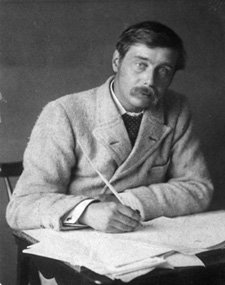
The atomic bomb was “invented” by the same person who invented the armored tank, trench warfare, the bombing of cities from the air, suburban sprawl, the Blitz, television news and the Time Machine. Though the first such Bomb would not be built and exploded until 1945, H.G. Wells foresaw-—and named—the atomic bomb in 1913, in a novel called “The World Set Free.”

This novel, written before World War I, was not just remarkably prescient. It actually affected the real development of the atomic bomb.

[text continues after illustrations]

H.G. Wells Posted by Picasa
Physicist Leo Szilard read “The World Set Free” in Berlin in 1932. Its story—of the discovery of atomic power, of the ensuing atomic war that destroyed the world’s major cities, and that war’s outcome—deeply impressed him. About five years later, a number of puzzling experimental outcomes were beginning to suggest the reality of what Wells had proposed (based on his intuition of what Einstein’s 1905 theory of relativity and Frederick Soddy’s work on radiation implied): splitting the atom to release immense energy.

In 1938, when Szilard realized how to create a chain reaction, he remembered Wells’ tale of a disastrous nuclear war. Until Hitler took over in Germany and even for awhile afterwards, discoveries in physics were freely shared internationally. But warned by Wells’ novel to the danger of his discovery, Szilard decided to keep it secret.

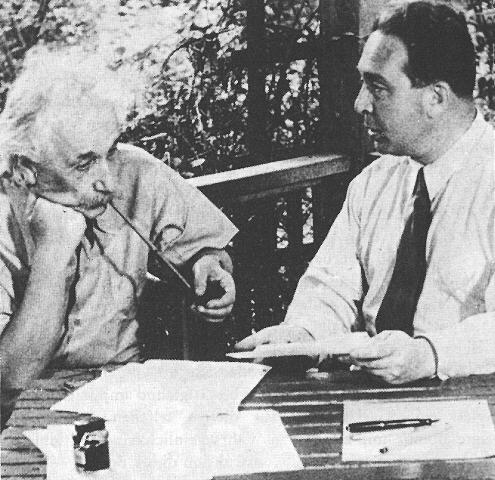
Szilard left for America, where he worked with Enrico Fermi, who had emigrated from Italy with his Jewish wife when Mussolini began to adopt Hitler’s persecution of Jews. When Szilard was sure an atomic bomb was theoretically possible, he discussed it with Einstein, who had also recently fled to America from Berlin. As a result of their discussion, they wrote the famous letter to FDR that Einstein signed, warning of the Bomb and the likelihood that Germany would pursue it, and urging the U.S. to develop it first.

Szilard eventually worked on the Manhattan Project, but when Germany was defeated and no German Bomb had been built, he got Einstein to write another letter to FDR, urging that the U.S. Bomb not be used in the war. After FDR’s death, he also led 69 other Manhattan Project scientists to write and sign a similar letter. He argued that using the Bomb against people would undermine the moral authority of the U.S. after the war, especially its ability to bring “the unloosened forces of destruction under control.”

Szilard realized two things that he might also have learned from Wells’ novel: because it was so immensely destructive, the atomic bomb was going to be the center of the largest moral questions the world had ever faced, and the geopolitical reality of the world had changed, because warfare with atomic weapons could destroy civilization and perhaps humankind itself.

These two areas—the moral and the geopolitical—were fused together by the first atomic explosion. They are fused together still. But for the purposes of analysis, let’s look at them separately.

Einstein and Leo Szilard Posted by Picasa
Morality, War and the Bomb

When Islamic armies were the most powerful in the world, conquerors of Asia Minor and North Africa, and poised at the gates of Europe in the 8th century, Abu Hanifa, founder of a school of law in the city of Baghdad, proposed that the killing, maiming and raping of civilian noncombatants in war be forbidden. It was one of the first attempts to codify some kind of moral and legal restraints on civilized societies engaged in the dangerously uncivilized practice of warfare.

Though from its inception, the intent of bombing was to terrorize people rather than to destroy military targets, there was still widespread moral opposition to the bombing of civilians and cities, until World War II. The moral outrage expressed in probably the most famous work of art depicting warfare, Picasso’s “Guernica,” immortalized the horror of the first terror bombing of a civilian population in Europe, by German bombers aiding the Franco forces in Spain.

While Americans remember the bombing of Pearl Harbor (a sneak attack, but on a very military target) and the British remember the Blitz, Germans may be justified in recalling the years of nightly bombing by British planes, culminating in the firebombing of Dresden, and Japanese the incessant bombing of practically every city in Japan by Americans.
By the time of Hiroshima, bombing cities with the express purpose of destroying them and killing people was a regular feature of the war on all sides.

But people were still troubled by the morality of killing the innocent, even when they half-believed the half-truths of their governments about the purpose and necessity of the bombing. The atomic bomb was so destructive over so large an area, that any pretence that it was a strategic weapon was impossible to maintain. “In 1945, when we ceased worrying about what the Germans would do to us,” said Leo Szilard, “we began to worry about what the United States might do to other countries.”

When the world began to find out what really had happened in Hiroshima, moral revulsion became attached to the Bomb and its future. After “Hiroshima,” John Hershey’s account of the aftermath was published, this revulsion was particularly acute. Even American military leaders, including General Dwight Eisenhower, Admiral William Halsey and General Curtis LeMay condemned the dropping of the bomb on Hiroshima and Nagasaki. General Omar Bradley referred to “nuclear giants and ethical infants.“

Leo Szilard asked people to imagine what the feeling would be if Germany had dropped an atomic bomb on an Allied city, but still lost the war. Would not that act be added to other war crimes at Nuremberg?

Though some of these figures became nuclear weapons supporters, moral revulsion became a widely and deeply felt reason for why the Bomb had to be controlled, and why it must never again be used.

Civil Defense collage from the 50s/60s Posted by Picasa
The Geopolitics of Apocalypse

In Wells’ 1913 novel, The World Set Free, the atomic war leads to the inevitable conclusion that the world must unite in a single World State, or destroy itself forever. In the novel, the world does unite---something else that Leo Szilard may have learned from it.

After Hiroshima, many others quickly came to a similar conclusion. Not only scientists like Szilard and Einstein, but writers like Norman Cousins’ whose essay published immediately after Hiroshima, expanded into a best-selling book, suggested that humankind now faced extinction in an atomic war, and only a new world order could prevent it. The main test humanity faced, Cousins wrote, is the “will to change rather than [the] ability to change…That is why the power of total destruction as potentially represented by modern science must be dramatized and kept in the forefront of public opinion.”

Cousins supported world federalism, and a United World Federalist movement arose in 1947. Though many people considered world government as too idealistic, there was widespread support for the United Nations as it was being formed, and something amounting to almost a consensus that nuclear weapons must be brought under international control. Even President Truman, who never regretted using the Bomb, believed that international control of atomic weapons was the correct goal.

But nothing close to world government or even international control of nuclear weapons ever materialized. Instead there was an arms race, principally between the U.S. and the Soviet Union. As nuclear weapons grew in power and number, the basic sanity of humanity was called into question. But as close as the world was to total assured destruction, it did not happen.

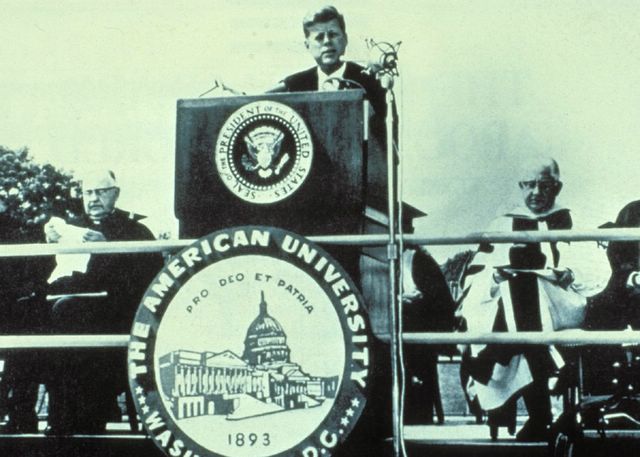
JFK's American University address in 1963 began the process resulting in a series of international agreements on nuclear testing and non-proliferation---which the Bush administration is dismantling. Posted by Picasa
How the World Saved Itself

What did happen was something few could have imagined, because it seemed so contrary to human nature and human history. Without the restraint of world government, the nations possessing nuclear weapons engaged in warfare and the undercover violence called the Cold War. But for sixty years and counting, no nation ever used a nuclear weapon against another.

Why they didn’t is not as important right now than the fact that they didn’t. The world was saved by forbearance. It was saved by the common knowledge that if one nation used a nuclear weapon, the restraint on their use by other nations would be broken. It was saved by a combination of moral revulsion and geopolitical realities.

Despite such pipedreams as fallout shelters and Star Wars, it was commonly known that there is no defense against nuclear weapons, and immense destruction was assured. Eventually there were international agreements that limited the proliferation of nuclear weapons, and allowed the major nuclear powers to limit and then reduce their weapons. But forbearance was the key to it all.

The U.S. under Bush has largely repudiated or violated many international nuclear weapons agreements. It has attempted to aid another nation (India) in expanding its nuclear capabilities. It has planned to add to its nuclear arsenal. And now, under Bush, the first and only nation to use a nuclear weapon against an enemy population of men, women and children, is said to be contemplating the first use of such a weapon since Nagasaki in 1945.

The consequences of thermonuclear war between the US and the USSR were studied repeatedly, and in outline were well known: basically the annihilation of civilization. The consequences are not widely known of nuclear devices becoming acceptable weapons in warfare at a time when many nations have some. But it can hardly be doubted that this is an avenue to widespread catastrophe that may have the same eventual result.

If the U.S. uses even one “small” nuclear device, the forbearance will be broken. The moral revulsion and geopolitical realism could be cast aside, and nuclear warfare of an unpredictable kind could begin, with no way to end it.

Posted by Picasa
But what if moral revulsion and geopolitical realism holds? What if the only nukes that are used turn out to be the ones the U.S. uses on Iran, at least in the immediate aftermath? The consequences for the U.S. could well be severe and lasting. Much of the world is already troubled if not disgusted with recent U.S. international behavior. (See for example the dKos diary by NBBooks that outlines several growing alliances that don’t include the U.S.) The use of any nuke could unleash a tide of sentiment and action that could devastate the U.S. politically and economically. Nuclear weapons still have potent symbolic as well as physical power.

The U.S. could become an outcast giant overnight, drummed out of the international community, treated with contempt. Real penalties could be exacted through the UN and other international bodies. Now that other nations are economically strong and America makes little of what the world needs, there is less incentive for allowing this violation—this most violent single act since World War II-- to be forgiven and forgotten. As our debts are called in, America may find that its chief exports—Hollywood, weapons and garbage—are no longer sufficient to balance its offenses.

Even if nations are cowed into silence by the U.S. willingness to use its greatest remaining source of world power—its nuclear arsenal—terrorism against the U.S. would undoubtedly increase, but the rest of the world will turn a blind eye.

To break the nuclear peace is potentially the most consequential single act possible. For it is only the remarkable shared forbearance on the use of nuclear weapons, a forbearance unique in human history, that has allowed civilization to continue. No matter how I look at it, it’s hard to see this any other way: the day that America uses a nuclear weapon against Iran will be the darkest day in American history.

Thursday, May 11, 2006


A Civil Defense poster from the 1950s Posted by Picasa
Nuking Iran: Radiation


Secrets and lies have driven the history of the Bomb. We see this pattern repeated today, in an effort to make nuclear weapons seem no different from other explosives. But with continuing signs that the Bush administration may be heading for war on Iran, with reports of U.S. officials considering using nuclear weapons in Iran, these lies become even more dangerous.

The most important secrets and lies concerned radiation, the distinguishing effect of the Bomb, beyond its sheer power. The effects of radiation were denied, dismissed and minimized for decades. Today they are not even mentioned. It is especially important to revisit this history because, according to the the Physicians for Social Responsibility, a nuclear earth penetrating weapon “would actually create more fallout than a ground-burst or airburst weapon, due to the increased distribution of radioactive debris from detonation at a shallow depth in soil or rock."

Those of us who are early Baby Boomers particularly, but any of us who lived through the Cold War, will have lived through these cycles of fear and denial before. I was born as the first postwar atomic bomb test was happening in Bikini, during Operations Crossroads. My first actual political memory was of wearing an Adlai Stevenson button in 1956, partly because I didn't want radioactive fallout in my chocolate milk. We are in a unique position to know what nuclear warfare might mean, and we need to spread that knowledge.

Radiation and the history of denying it and confronting it is the subject of this essay.

[text continues after photos]

Operation Crossroads "Baker" test July 25.1946. Posted by Picasa
From its very beginnings, the atomic bomb has been mysterious. Even the physicists who lived together in Los Alamos to develop it did not know what they had invented. They didn’t know how powerful the first Bomb would be—they had a betting pool on the yield, and many seriously underestimated and overestimated the result. About half the scientists didn't think the device would explode at all. Enrico Fermi was taking bets on whether it would burn off the Earth's atmosphere.

But most of the mystery was deliberate. The Bomb was developed in complete secrecy so as not to tip off the Nazis, who were believed to be working on their own Bomb project. Even after Germany’s defeat, the Bomb was kept secret from the remaining enemy of Japan, but also from America’s war allies. Then after the war, as the truth of what the Bomb’s effects became clear to scientists, the American military and Washington policymakers tried to keep some of those effects secret from U.S. citizens, even to the point of outright lies.

The Bomb produces three effects: blast, heat and radioactivity (commonly called radiation.) The blast is immensely more powerful, and the heat is immensely more intense, than any other manmade device can produce. Together they resulted, in the Bomb’s first test, in killing every living thing within a mile, including insects. A single Bomb each virtually leveled the cities of Hiroshima and Nagasaki. Human beings were vaporized. Nothing was left of some but their shadows burnt into concrete. Others were seared to a small pile of ashes. The remains of some were fused with metal doors and other objects.

Those effects were immediately apparent. But it took some time for the effects of radiation to be understood, and even longer to be acknowledged.