Showing posts with label my 1960s. Show all posts

Tuesday, April 01, 2008

The Cruelty of Hope

In 1968, this was a happy day. There weren't many that year. But the night before, on March 31, President Johnson ended a TV address with the words we thought we would never hear, "I will not seek, and I will not accept" the Democratic nomination for reelection to the presidency.
I watched it on the nearest TV set, which was several doors down First Street in Galesburg, Illinois, at the home of my writing professor (who was married, with two young daughters, and not more than 5 years older than me.) It was literally shocking, the kind of statement that displaces time: you feel you started to hear the words before he said them, and then afterwards you can't believe that you actually heard them.
LBJ was stubbornly expanding and prosecuting the Vietnam War, and the demonstrations that were growing in size and emotion routinely included the chant, "LBJ, LBJ, how many kids did you kill today?" But now, in an instant, he was not going to be there, and the only two declared Democratic candidates were running to end the war: Senators Eugene McCarthy and Robert Kennedy. We were really going to end the war!
Of course, I knew that in some ways it wasn't going to be soon enough for me. I'd already had my pre-induction draft physical, and despite total deafness in one ear, and to the complete shock of several sets of draft counsellors I saw in Chicago, I'd passed. (They were already telling me about how to appeal.) I was a senior in college, and in a few months, my student deferment would end, and with draft calls still very high, I'd probably be drafted. I still hadn't decided what to do, except I knew what I wasn't going to do--I wasn't going to kill any Vietnamese. There was a lot of talk about options, but in the end no one else could really understand this decision--not parents or teachers, friends or certainly girlfriends. You were alone on this one.
But that was a couple of months away at least. I was about to direct a play I'd written, with its own statement about all this, and after that I could probably tie up the draft process long enough to somehow work for Robert Kennedy's campaign. And it was April--spring was short but intensely beautiful in Galesburg--and the barrier of LBJ was gone.
There'd been dancing in the streets on campuses across America the night before. There hadn't been anything that public on our small campus, but we'd probably celebrated enough to be seeing the first April morning through a slight fuzz. There was hope now-- the war might end, and that immense burden on every single hour of every day.
April 1--April Fool's Day. Before the month was out, Martin Luther King would be assassinated, and hardly more than a month after that, I would spend my graduation day watching Robert Kennedy's funeral. Then would come the shambles of the Chicago convention, Humphrey, Nixon and more war--much more war. "April is the cruelest month," T.S. Eliot wrote, as we students of literature well knew.

Monday, February 05, 2007

Vietnam and the 60s: Phantoms and Realities

Dailykos the other day had prominent threads on two new books that concern the 1960s and Vietnam. One by devilstower was about The Spitting Image by Jerry Lembke, which debunks the media legend that protestors spit on returning Vietnam veterans. I have to confess that even I was taken in by this right wing smear. Emotions did run high, and I guess I could picture protests getting out of hand. Now I'm not sure what I remember versus what I saw in the movies about this. I know that there were protests at recruitment centers and draft boards. We protested ROTC and recruiters on campus (on our campus we did so by singing "Alice's Restaurant" at top volume.) But the image of protestors lined up at airports to dis returning soldiers comes not from history or reality but pernicious fiction.

I do clearly remember finding common cause with returning vets, and obviously many of them eventually became active, and became leaders, in the antiwar movement, just as Iraq vets are doing now. Even the young officer in charge of my group at my (first) draft physical closed the door at the end of it and told us that Vietnam was a crock and to stay out of it in any way we could. I also remember that protestors were spit on, as well as clubbed, gassed and punched.

As devilstower points out, the spitting on veterans lie was part of the attempt to spin the history to say that the U.S. lost Vietnam because of protestors, lack of support at home and the resulting lack of will by spineless politicians. It appears to be the argument that George Bush buys, and that informs his prosecution of Iraqnam.

The other frontpage post was by SusanG, about Jeff Kisseloff's Generation on Fire, an oral history told by 1960s activists. She also provided a link to Jeff's website , which will soon be a permanent link from this site. Susan (as usual) provides a thoughtful analysis of what she learned from these interviews (there are some on Jeff's site that aren't in the book) that pertains to progressives and activism today. I'm looking forward to exploring Jeff's site in detail and his book, but one thing is already clear: the "spitting" protestor is a phony phantam of the 60s, so it's about time to hear a little more of the reality.

Friday, August 04, 2006


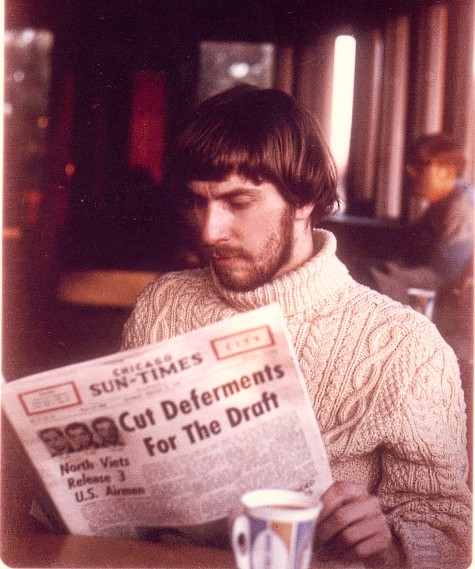
a fateful moment at the campus coffee shop.
photo by Bill Thompson. Posted by Picasa
Wars Within Wars

The Iraq war is becoming as long and agonizing as Vietnam--one poll says it is even more politically divisive. A Republican Senator said that the situation on the ground in Iraq is an "absolute replay" of Vietnam. A reporter who covered Vietnam sees a tragic repetition of the Vietnamization policy of the Nixon war, during which most Americans were killed and most of the destruction was done. And there are other resemblances as well.

Rather than make comparisons for you, let me simply tell a few stories about that time that seem relevant. These are recollections, with some poetic license, and like all stories, just one way of telling about it.

I obviously can't speak for everyone who was young in the Vietnam era. So when I say "we," it's shorthand for the people I knew. However, there were a lot like us. If you were draft age, and especially if you were in college, you were involved in these discussions to some degree.

Some of us talked about Vietnam and associated moral and political issues virtually every day. Some years (for me, the late 60s) there was hardly a conversation in which these subjects didn't come up.

There was one set of discussions about Vietnam: the politics, history and other contexts of the war. These began with the campus Teach-Ins in 1965 and became a major part of our education.

All of these discussions were in the context of a lot of information on campuses and in print--books, and extensive journalism, analysis and argument in the New York Review of Books, Ramparts and other publications. Many organizations sprang up and issued pamphlets, booklets and newsletters.

We listened to new young leaders and to established public figures, more and more of whom--from old Left firebrands and new poets to anthropologist Margaret Mead--were talking about the war and all the issues involved.

We also had novels (like Catch-22, Slaughterhouse Five) and poetry influencing the discussion. And especially music, that dealt with issues pretty directly (Dylan's "Masters of War" for example) or contributed in terms of spirit, and of suggesting alternative culture and ways of being.

There was a related set of discussions having to do with the morality of participating in an immoral war. It had to do with decisions that young men like me were being forced to make, because we were being drafted. For us, the discussions went beyond politics and academic discourse. We were trying to decide what we were going to do, because we were being forced to make a decision, about our lives, about life and possibly death.

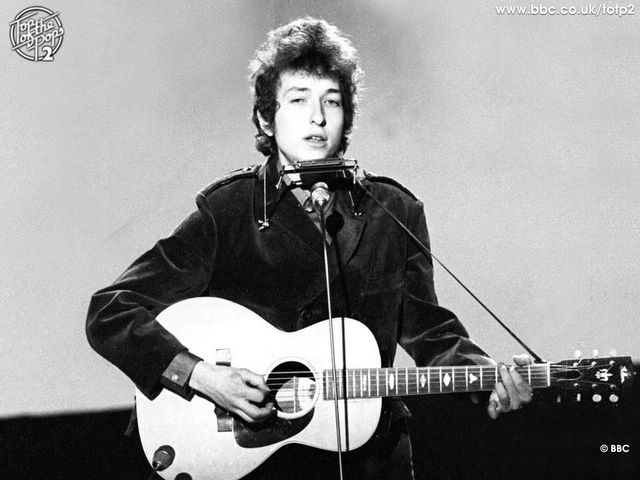
Bob Dylan Posted by Picasa
I turned 18 in the summer of 1964. I walked down the alley from the building where I was working, for the Voter Registration Drive sponsored by the Democratic Party and the local of the AFL-CIO's political committee, called COPE (I don't remember what the acronym stood for) to the draft board registration office. Actually, I hobbled. I was on crutches from catching a football as I was falling into a ditch. I don't recommend it as recreation.

I had the student deferment (2-S) during college, but we still had to report for physicals when called. I got called in 1967 during the highest draft call month of the war. My first physical was in Chicago, a chaotic nightmare of hundreds and probably thousands of young men in their underwear standing in lines and filling out forms.

We quickly learned that who passed and who didn't was almost entirely arbitrary, based on whether the person examining you at each station wanted you to get out or not. In my group, the top swimmer on our college team got out because somebody was a fan of college athletics. I was in the next line, and I was (and am) entirely deaf in one ear. I passed.

I also remember the young officer (a white guy) in charge of instructing us on filling out our forms. He was very authoritarian and by the book. Then when we were done he closed the door, and told us that anybody who went to Vietnam was a sucker, so get out any way you can.

Before that day and after, I consulted draft counselors in Chicago. There were several sets of them, from various organizations, and although they all gave you the information you needed about your rights, and the forms, etc. they each advocated a different approach to resistance. The Quakers advocated conscientious objector status. A more political organization preferred overt resistance, and jail as protest. However, by the time I was drafted, at least one of these groups changed their tactic. Draft protestors were singled out in prisons, they learned, and so they advised against going to jail if you had any other alternative, such as leaving the country (which generally meant Canada.)

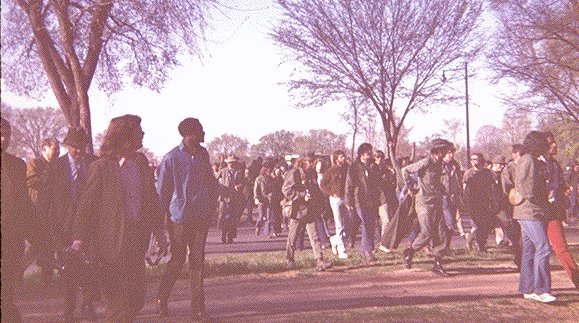
March on the Pentagon 1967 Posted by Picasa
The moral questions we had to answer were many. They started with locating our beliefs about war. Am I against this war, or all wars? Under what conditions would I fight or kill?

Is it moral to avoid the draft when another will have to take your place? Is it moral to accept the draft and refuse to be a combatant, meaning another will take your place on the battlefield? On the other hand, is it moral to do anything, inside the Army or outside, that enables the war machine to continue?

For draft age men, there were practical questions that resulted from these quandaries. When I am called what should I do? Do I comply and hope for the best, hoping that either I don't get into combat situations or that I will make moral decisions if I do? Go into the army, and request a non-combatant role? But aren't non-combatants enabling others to kill, and isn't that equally immoral?

Do I resist and go to jail, and risk being in situations where I choose between being harmed and harming? Again, the issues of violence and nonviolent resistance.

Do I refuse by going to Canada, leaving behind everything and everyone I know?

To help answer these questions, we learned more. We learned more about how we would be trained, how the military worked, and how that would limit our choices once we were in it. We learned a little about what we could expect in prison. There was even less information on Canada, but we knew it meant we couldn't return, even if our families accepted our decision.

This makes it sound like a wholly rational procedure. It wasn't. It was nuts.

We saw a memo purporting to be a Selective Service document called "Channeling." It said that part of the purpose of the draft was to channel young men into activities that help the state--either in the armed services or into war work areas that were deferrable (weapons research perhaps), or if they were malcontents and protestors, channel them to jail or out of the country.

Those not faced with these imminent decisions debated the best ways to resist. Work within the electoral system--though there were few antiwar candidates? Was revolution the only answer? Analysis of the war led to analysis of reasons for the war, which led to moral issues involving racism, cultural as well as political imperialism, the military-industrial-academic state.

We spent a lot of time talking to each other about these issues, and trying to persuade other guys that fighting this war was wrong, that the army wasn't what they thought it was, and once they went in, they would regret it. These got to be passionate arguments, with a lot of angry words. Some women ended up in tears of frustration and sorrow for what these young men would be doing, and doing to themselves.

Besides the draft, there were also recruiters who came to campus, and we had ROTC on our campus as well. On the theory that reducing the number of people who go into the armed forces would reduce the ability to fight this immoral war, we protested recruitment on campus, and harassed recruiters when they showed up. We challenged them, as we challenged politicians, to start telling the truth. Because they were all lying, just about all the time.

There was no active protest against ROTC on my campus that I recall, but I do remember looking up from a newspaper I was reading in the student union to see a classmate in his ROTC uniform, and spontaneously giving him the Nazi salute. To me this was a bit of guerrilla theatre, something out of a Beatles movie even. But to him, as it turned out, it was very disturbing. We had a long talk about it on the patio outside the union building many months later, just before graduation. He told me his feelings about defending the country, and learning about honor and duty, and also about trading a couple of years in the Army for what they paid towards his college education. I told him my feelings about protesting the war and refusing as a patriotic act, and so on.

It was a sad conversation--especially since graduation was taking place at the same time as Bobby Kennedy's funeral-- but a real one. I'm glad we had it. A few weeks after graduation he was sent to Vietnam. He'd been there for two weeks when he was killed.

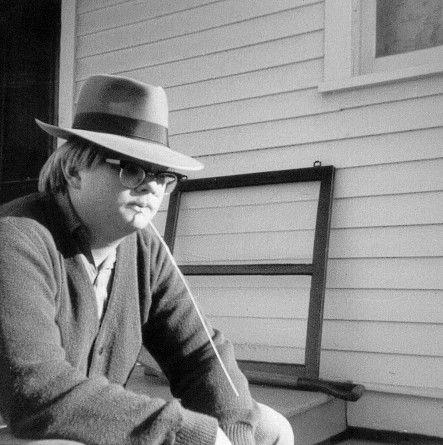
Buffy Sainte Marie Posted by Picasa
While months earlier, as I agonized over all this, I used every delaying tactic and bureaucratic opportunity I could to delay induction. By the time my induction physical was scheduled for Fort Des Moines, Iowa, I knew what I was going to do. First, I knew my rights down to the paragraph, and what appeals were due me. I had all my hearing tests and other information about possible physical disqualifications.

If all my efforts failed, I would refuse induction by stepping back when the oath was given. That would trigger more appeals. In the meantime, I had my conscientious objector papers ready to file. CO status was hard to get if you weren't a member of a church recognized as pacifist. I was raised Catholic, and the Crusades weren't a real good precedent.

But if I was going down, I would go down writing. I remember including the lyrics of a song called "Universal Soldier," written by Buffy Sainte Marie, but made popular by Donovan. It began:

He's five foot two, and he's six feet fourHe fights with missiles and with spears......He's the one who gives his body as a weapon in the war and without him all this killing can't go on...It ends:He's the universal soldier and he really is to blameHis orders come from far away no more/they come from himAnd you and me/and brothers can't you see/this is not the way we put the end to war.

I had come to the conclusion that it was a violation of my constitutional rights to be compelled to kill somebody. So I wrote that. I felt putting myself in position to be told to kill somebody, or to aid in killing people, without my informed consent, was immoral. I said that by pursuing an immoral war, the government and the army had ceded its moral authority.

But I had also come to the conclusion that personally I would not survive the army of these times. I was convinced that whatever I had that would be of use to the future would be destroyed in the army. It would drive me crazy in one way or another. (And in that I was sort of proved right.) Jail was the same kind of alternative. If I let them force me into one or the other, I figure they'd won. The war against the war was a guerilla war.

So if all else failed, I was going to head for the border. This was a big deal for me, because I had little conception of how I would survive. I've never been good at the making a living part of living, and I was really naïve then. My family was sympathetic about what I was going through, my parents didn't necessarily support the war (they had doubts) but they were frightened to death of the idea that I might refuse induction. And in any case, you soon learned that when you face these decisions, you really face them alone.

I took a long bus trip from Iowa City to Fort Des Moines, paid for by the Army. As I was the only member of my group on this trip, I was designated by the Army as the head of it. It was my first and last command.

I bunked at the barracks with a lot of farm boys pleased as punch to be going into the army and getting away from home, plus a few other college kids who found each other quickly and formed a squad for mutual self-protection. The army guys in charge pushed the kids around, but left us on our own.

My physical turned out to be a battle between the sergeant at station #1, regular army (black), who was thorough and flexible to the point that I was certain he was more than ready to let anybody who didn't want to be in the army just go home, and the doctor at station #9, a draftee (white) who eventually told me that no matter what I did or what my test results said, he was going to pass me, because if he had to do his two years, everybody did.

RFK campaigning in 1968 Posted by Picasa
This physical lasted three days. I had my hearing tests, and #1 sent me to a doctor in town for confirmation. With confirmation in hand I went to #9, who passed me. Same with other physical ailments. But I was getting the idea that #1 was going to let me string this out as long as necessary, so I began inventing things. I filed petitions based on the first ten amendments, separately, and on the UN Declaration of Human Rights. I wrote in rhyme wherever possible. I moved to the psychological claims.

As a kid from a working class culture I'd never even seen a psychiatrist up close before, but they sent me to a couple. After two and a half days of this, I was pretty convincingly crazy. I thought there was a film crew following me. To this day I don't know if it was a hallucination or not. Just before one of my appointments, I was facing a closed door. After twenty minutes or so, I saw the door open and a nurse come out of a broom closet, smiling at me. That's when I went in to see the shrink.

There was a different #9 that day and they wished me good riddance. They also told me that I'd never get a real job with this on my record. It took me a long time to recover from that period of time, the year or so from the first physical to the second, and I doubt I did completely. Between the two, Martin Luther King was killed, and the candidate I counted on to end the killing, Bobby Kennedy was killed. In the chaos of all this I couldn't take certain courses seriously and fell slightly short of my graduation requirements. Others of lesser academic standing had been given a waiver when they were that close. But as a well-known antiwar loudmouth, I was not.

I guess I've gone on so long about this to give you the context for what I'm about to say, which is the point of this diary. I did what I had to do to survive, body and soul. I did not survive unscathed. No one did. There were no moral certainties and though I'd been excessive at times in my criticism of those who became part of the war machine, I was ready to see things in a context which was in some ways larger, and in other ways, very specific.

I am not for a moment trying to say my experiences were equivalent to what soldiers went through in Vietnam. I was in a lot of protests, got into a few scrapes when total strangers could be violent because of your hair length, and caught my share of tear gas, but it's a whole different order from being under fire, in that context day after day, and coming home with those kinds of wounds. And for the record, I never spit at a returning soldier. Ever.

1967 at the 169 W. 1st St. Home for the Bewildered.
Is this a future Canadian MP? Posted by Picasa
In personal terms, I was already clear about each of us making the best decisions we could at Christmastime the year of the Christmas bombing, when our families were trying to be cheerful and live in happy America, and my best friend from high school and I were talking about what we were going to do about our draft notices. His decision was to accept induction, to request non-combatant duty. If he was ordered to Vietnam as a combatant, he would refuse to go.

I understood his decision and supported him, as he understood mine and supported me. We were as close to being brothers as I've experienced. Eventually he was inducted and sent to Korea as a chaplain's assistant. I wrote to him and sent him packages, which considering the shape I was in at the time, was considerable effort.

Later, I expanded this horizon and it happened like this: I was hitch-hiking at the edge of a highway, and saw a guy in an army uniform running towards me. This didn't look good---me with my long hair and guitar case. But I stood my ground and waited. When he got to me he was beaming. He had just gotten out, and he was happy to see anybody who looked like me. You guys were right, he said.

Shortly after that I began hearing about Vietnam Vets Against the War and this guy named John Kerry. They were at the next big demonstration in DC, so I marched behind them. My band of brothers had expanded.

Of my old friends from home, three had been in the Army, two of them in Vietnam. One was decorated for bravery under fire as a medic. The other, the kid from the African American family next door who I played war with when we were little, was an officer and also a hero. He saved a bunch of lives, and did all kinds of good things back in the states. There was a street named after him somewhere. As I'd generally been his commanding officer at home, being the one who made up the story we played out, I took some satisfaction in this.

My college housemate moved to Canada--I drove a van load of his stuff to his new home. He still lives there. He's thinking of standing for the legislature. Another protestor I knew from college used to be the chief of staff at the White House. After working to register voters for LBJ, I'd protested against him, and that burned my political bridges back home.

We all made our decisions, we all lived our lives. I don't judge others' choices, even though a lot of judging still goes on. Some Vietnam vets have never forgiven civilian protestors, even after reconciling with their adversaries in the field of battle. I don't understand that exactly, but I accept it. Still, many vets and protestors did reconcile, did come to a common understanding that we all make choices, according to circumstances we found ourselves in; according to the cards we were dealt. And we all have to accept the consequences.

In the heat of the moment, some men in Vietnam committed atrocities. They have to live with that, and with whatever judicial consequences ensued. I don't entirely agree that given the same circumstances we all would make the same decisions, but I was sure that I would not allow myself to be put in the position of having to make those kinds of decisions. Not in that war. That these guys in Washington wanted to put me in that position still makes me angry.

Kurt Vonnegut, Jr. Posted by Picasa
Somebody who I respected, an older established writer named William Eastlake who was a World War II vet and opposed to the Vietnam war, cautioned me against becoming a pacifist, because you never know, a righteous war might just come along. It was pretty unlikely, but possible. I went with the unlikely part. I went with what I knew about the people leading the government then.

I believed concretely that to deprive an unjust government and an immoral war of your body as a weapon is a moral act. I believe that in the abstract it is wrong to do anything to further an immoral war. But I made decisions on just how far I would go with that, and others made different decisions, if they even believed that. Nobody had to pass any sort of test to march against the war, or vote against it when they got the chance.

I honored and supported war resisters then, both in and out of the armed forces, and I do now. I don't judge the soldiers who are in Iraq, not without knowing their story. They're only a pawn in the game of the Masters of War. I've got a relative there now, the husband of a cousin's daughter. We pray for his safe return. My best friend's daughter is married to a Iraq war vet. She's a wonderful kid and she's helping him adjust. I haven't met him yet but he sounds like a great guy. He's working in alternative energy.

It all makes me think of the introductory chapter to Vonnegut's Slaughterhouse Five, in which he and his friend sit down with a bottle of whiskey to recall the war, but the friend's wife is hostile. Vonnegut asks her why. She says because you were all just children then. Vonnegut agrees, and he subtitles the book, the Children's Crusade.

Look at the faces of the Americans over there, especially the dead. They are children. Now some of them are dead children.

1971 March in Washington led by Vietnam Veterans Against the War Posted by Picasa
The organization I know the most about, and I respect them tremendously, is the GI Rights Hotline. The local group is composed of lawyers, physicians and educators, and lots of Vietnam vets. (I wrote about them here.) They are fighting against war "one soldier at a time." But they support the soldiers they counsel. They try to help them get their rights to medical care, and to help for their families. How the warmakers in Washington treat soldiers and their families is deeply immoral, a complete scandal.

But the Hotline also counsels kids being recruited in high schools, telling them about the empty promises and outright lies by recruiters. Some will go anyway, to get away from home, to meet new people, which they will. Some will change their minds after what they see and experience, and want out, and the GI Rights Hotline will try to help them.

When I was junior high age I had a plan to go to the Naval Academy. I probably could have gotten the congressional appointment. But then I found out I wouldn't be accepted, because of my hearing. The clarity of chain of command, the discipline, the dedication to duty appealed to me. It still does to some extent and it may yet prove useful, though I doubt it will be in a purely military context.

Another echo of Vietnam, though a perverse one, is a call by some ( including progressives) for the return of the draft, as some kind of national service requirement which would offer "choice" other than military conscription. I hope some of the practical objections to such a naive notion are obvious after reading this account. But even in a better world, I would never compel anyone to do any kind of "service." Compulsion is just plain wrong. When we need selfless service, and we have mechanisms worthy of that dedication, we won't be in short supply. After all, people are ready to join Starfleet right now.

Thursday, July 06, 2006


Posted by Picasa

Turning 60

Act III

As I begin writing this, I am 59. When I finish it, I will be 60.

How do I think about turning 60 years old? Some look at how vital we are at this age in comparison to our parents’ generation, and say we’re still young. Or at least in middle-age. You might make a case that these days our youth lasts until 40, and middle age extends to what used to be the retirement age of 65. But as Michael Ventura points out, we’re not living to 120. Sixty isn’t the middle. We aren’t young, in Act I of our lives. We mostly aren’t in Act II anymore.

This is the start of something different. It is early old age---maybe even “young old age” if that feels better. In the theatre of our lives, it’s the curtain coming up on Act III.

This is going to be happening to a lot of people starting about now. When the battleship Missouri was steaming into Tokyo Bay to accept the surrender of Japan, my parents were marching up the aisle of the Blessed Sacrament Cathedral in Greensburg, PA. I was born the following June, making me one of the first of the postwar Baby Boomers, and so one of the first Boomers to turn 60. There will be millions more over the next decade.

Turning 60 is a hard thing to admit, even to ourselves. There is a shame attached to it in today’s world. Younger people and even our contemporaries look at us in a different way, and treat us differently. Of course, this happens anyway, whether we admit it or not, and whether or not we announce our identity in this way. Do we say we are 60? Claim the senior discount? It’s scary, maybe even depressing and demeaning.

Part of the scariness is obviously that getting older inevitably places us closer to death. More people we know or know of, people we grew up knowing or knowing about, are suddenly dead. We shudder when this includes our contemporaries, or even those slightly younger. It is hard to accept that we have fewer days ahead than behind. Maybe it’s even harmful to accept it?

Like anything important, both sides of the contradiction are true in some way, and must be embraced, reconciled. There is pain in coming to terms with Act III. But there is also freedom, and purpose.

Emphasis is a way of considering one side, before considering the other. Two texts have been important to me in the past few years in this intermittent but intense effort to figure out how to proceed. The first is an essay published in a fairly obscure journal by Michael Ventura, a columnist, essayist and novelist who was approaching 60 when he wrote it in late 2004. The second is James Hillman’s book, The Force of Character, first published in 1999. It so happens that Hillman and Ventura collaborated on an earlier book (We’ve Had A Hundred Years of Psychoanalysis and the World is Still a Mess.) So though they differ on some points, it seems to me they agree on most basic ideas. It’s mostly a difference of emphasis.

In his essay, Ventura emphasizes loss. This is natural for one approaching 60, and a necessary initiation. When I stumbled onto this essay (in a magazine I’d never seen before, called Psychotherapy Networker) I was jolted. It took me awhile to accept its premises. But in my own 59th year, I came to embrace it, guided by my own life to the truth of Ventura’s words.

The article is called “Across the Great Divide: Middle Age in the Rear-View Mirror.” It begins when Ventura realizes he must make a major change in his life. He can no longer afford to live as he had been in Los Angeles. He must find a new place to live. At the same time, he’s thinking about turning 60, and arranges to meet an old friend in Las Vegas. He drives there, taking a long and thoughtful route.

The statement that rocked me was simple: “When you’re pushing 60, the rest of your life is about saying goodbye.

“Your greatest work may yet be demanded of you (though odds are against that). You may find more true love, meet new good friends, and there’s always beauty (if you have an eye for it) and fun (if you haven the spirit)---still, no matter what, slowly, you must say goodbye, a little bit every day, to everything.”

Ventura’s examples are painfully familiar: you’re saying goodbye to your own face as it was in your youth; to how you drove a car (he mentions reflexes; I’ve noticed night-vision—my eyes don’t readjust from glare as fast as they did), to life without aches and pains, perhaps to certain strengths, and to access to your memory. “Alzheimer’s? ‘A senior moment’? You get used to it and hope for the best. Ain’t nobody can do a thing about it anyway. Goodbye.”

Yes, I know there’s advice out there on strengthening mental agility, and we can all be heartened by the research showing that brain cells continue to be born as well as die all our lives. But the basic point is sound.

Ventura is also saying goodbye to where he’d lived in the prime of his life. Though he isn’t saying goodbye to his career exactly—he writes a column these days for the Austin Chronicle--there is a sense that in some ways he’s doing that, too. Many of us at 60 are facing such a change. For those of us in a position to “retire” (leave our jobs and collect retirement benefits) it is also a time of taking stock of accomplishments, and saying goodbye to having any more, at least in that job. Financial retrenchment has its own set of goodbyes. In many ways, these all imply saying goodbye to possibilities, and perhaps to dreams unfulfilled.

[continued after photo]