Showing posts with label 60s heroes. Show all posts

Monday, November 02, 2015

Remembering John Lindsay

New York Magazine's website has an article celebrating 50 years since John Lindsay was elected mayor of New York City.  It briefly describes what made him different and memorable, backed up by some testimonials from now famous or influential people who worked on his campaigns or mayor's office.

I met or at least heard John Lindsay when he was a member of the US House of Representatives, before he ran for mayor.  I must have read an article about him, describing him as the Republican's JFK.  (In the above mentioned piece, Bob Dole talks about serving with him in Congress in the mid-60s, the time of Civil Rights and the War on Poverty.)  Lindsay spoke at a college near me (Seton Hill) and I went, and shook hands with him afterwards as I recall.  (But I could be wrong, because I think I took a date.  Who takes a date to a speech by a congressman from another state? In high school, me.)

This article describes Lindsay as frustrated by New York unions as well as unsympathetic administrations in Albany and Washington, but excelling in personal leadership--walking black neighborhoods almost every day, talking to people, getting involved personally in a jail hostage situation and thereby preventing bloodshed.

Lindsay was the Republican JFK (though he later switched to the Democratic party) also in that he inspired a generation, and is remembered with such gratitude and lasting admiration.

Wednesday, October 13, 2010

The Best Game Ever


Today is the 50th anniversary of what some experts call the best baseball game ever (and not all of them are from Pittsburgh)--the seventh game of the 1960 World Series, won by the Pittsburgh Pirates over the New York Yankees with what is still the only home run in the bottom of the ninth to decide a Series in the 7th game, hit by the Hall of Famer Bill Mazeroski. That's the sequence in the above pictures--the middle photo of Maz floating from second to third is the basis of the statue of him that will be unveiled outside the new Pirates ballpark.

It was a vastly different baseball world. It was the last year there were just eight teams in each of the National and American leagues, as there had been for most of the previous history of major league baseball. Though baseball was the biggest sport in America, most Major League players didn't even earn a living from baseball--many if not most had other jobs in the offseason, and went back to work full time when they retired. Though there were fewer games in a season (154 instead of 162), they were worked harder. The Pirates two top starting pitchers each had 16 complete games in 1960. Today a complete game is a rarity.

The game was played at Forbes Field, in the neighborhood of Oakland. It was a storied ball park even before this Series. Babe Ruth hit his last two home runs there. The old baseball movie, Angels in the Outfield, was shot there. It was torn down as the University of Pittsburgh expanded, and the Pirates went to play at the larger Three Rivers Stadium on the North Side, where the Steelers and other local teams played. Now Three Rivers is gone, and the new Pirates park goes a long way to recreating the experience of seeing a game at Forbes Field--where I saw my first games, including this 1960 team--but it doesn't quite get it all.

I was very fortunate to be a boy so into baseball when the Pirates were putting together this team, from 1958 to 1960. I met some of them then, including Roberto Clemente and Bill Virdon, and others later. Oddly, even though Bill Mazeroski became a member of my childhood church and to this day lives in my hometown of Greensburg, I never met him. (He was also the Pirate whose name was closest to mine, so that was what my next-door neighbor called me--hey! it's Billy Mazeroski!--even though Maz was a right-handed second baseman and I was a lefthanded pitcher, and my model was Harvey Haddix.)

That 7th game was full of odd events and improbable heroes, none more than Mazeroski and his home run. Maz is considered among the best fielding second basemen ever--if not the best-- but he wasn't among the Pirates best hitters or power hitters. No one expected him to hit a home run, especially since he'd already hit one in the Series (in the first game.) Fans just wanted him to get on base, and that's what he was trying to do. He took the first pitch for a ball, so maybe he could work a walk. Instead he hit the next pitch into deep left field and over or near the highest place, the scoreboard clock.

Pittsburgh hadn't had a sports champion since 1925, the last time the Pirates won the Series. But in that one moment, the already magical 1960 season became one that people will be talking about today, and Pittsburgh will celebrate again.

Thursday, April 12, 2007

Posted by Picasa

R. I. P.

Kurt Vonnegut, Jr.

He survived Pall Malls for 84 years, and it was a fall resulting in brain injury that led to his death. Kurt Vonnegut has been part of my life and close to my soul since the 1960s, when my fiction writing teacher who'd been his student at the Iowa Workshop got us reading his early novels, just a few months before the world discovered him big time with Slaughterhouse Five.
Of contemporary writers, I felt closest in ways I can't explain to two: Vonnegut and Gabriel Garcia Marquez.

His New York Times obit is here.

Vonnegut was one of the voices we clung to in those bitter years of the late 60s. His voice was so distinctive that it was something that writers attached to rhythmic mimickry had to get loose of. No sooner had you broken the habit of writing like J.D. Salinger, Hemingway and Joseph Heller, along came Vonnegut. So it goes.

He was a countercultural voice who came by it honestly; he earned it. His use of science fiction motifs was part of it, especially for me. In later years he took on the appearance as well as the mantle of our 20th/21st century Mark Twain.

I've known so many people who knew him, and I've seen him on various screens and of course read him, so I feel I did know him, in that peculiar way in which he didn't know me from Adam. I encountered him in person at least three times I can recall. He spoke in Pittsburgh, where the U.S. Army had once sent him to study engineering. His speeches, especially at colleges, are legendary--even the ones he didn't actually deliver. They were full of wit and practical wisdom, and lots of provocation of thought and feeling, worth any 20 political or academic talks.

Before that, he passed through my mind as I was walking in Boston one afternoon, idly thinking I might run into him. Late that night, while sitting in an unprestiguous, noisy, overlit restaurant with members of a rock band I was supposed to be writing about (the drummer lamenting the absense of the groupies he had been promised), I glanced across the room and saw Kurt Vonnegut looking at us, and not real kindly. Such a coincidence is common in Vonnegut's fictional universe, where there are "leaks" between worlds and time is permeable. It actually happened to me twice within a short time; the other time I was in O'Hare airport thinking about Paul Simon, and a minute later there he was. It was weird enough to be a little scary, and so it's never happened again.

The last time I remember was in Manhattan. It was on the street and I saw him walking towards me, wearing just a comfortable indoor sweater on a cold coat-and-scarf day. I recognized him and smiled; he looked at me the way I was often looked at in New York--that ' are you somebody I should know?' look--and when he'd concluded I wasn't, he looked away. But I have that picture of him, walking the midtown streets as if from one room of his house to another.

I was talking about a short story of his just the other day. Someone, I forget who, has recently written a satire in which the suggested solution to social security and medical care shortfalls because of aging baby boomers is to kill them--humanely, I assume. Apparently this idea is striking a chord, which doesn't surprise me. Vonnegut wrote about it in the 1950s, in a story called "Welcome to the Monkey House" (also the title of his first story collection.) Because of overpopulation, old people were encouraged to visit their government sponsored Ethical Suicide Parlors. It was a wicked idea, but what makes writers cherish Vonnegut is his imagination, his detail. These Parlors were housed next to Howard Johnsons, their purple roof next to the orange roof of HoJos. They all had Hostesses, stewardess-like young women who humor the old folks but efficiently hurry them along to take their injection and die peacefully in the Barcolounger. You absolutely know that when these places are established, this is what they will be like.

I've only quoted him here once, from a 2006 speech in which he said: “The only difference between Bush and Hitler is that Hitler was elected.” That's Vonnegut in a nutshell: vivid, combative, funny, outrageous, passionate, pushing at the edge but with wit and meaning.

Vonnegut often wrote about Kilgore Trout, his alter ego--a version of who he might well have been if it hadn't been for the sudden success of Slaughterhouse Five, a poor and obscure science fiction writer. In Vonnegut's last novel, Timequake, Kilgore Trout dies. He was 84.

Saturday, April 29, 2006


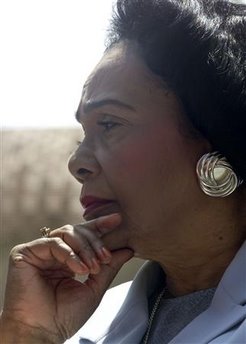
Coretta Scott King in 2002 Posted by Picasa
For Heroines of the Sixties: Statutes, Not Statues

In In These Times, Susan Douglas wrote a perceptive column about two prominent women of the 1960s who'd died earlier this year, Coretta Scott King and Betty Friedan. They both changed life dramatically for women, especially young women, of the early 21st century.

But though they were eulogized as heroes of perception (especially Friedan and "the feminine mystique"), Douglas points out another key to their achievements: But in addition to the lessons in courage the Democrats might take from these women, they might note that both women fought for concrete, systematic policies and laws—to be enacted and enforced by, yes, state and federal governments—that dramatically reduced and, in some cases, ended inequality.

Douglas reminds us of what life was like in the mid-1960s for women (gender-segregated help wanted ads in newspapers, few women doctors, lawyers or executives, no pregnancy leave, no sexual harrassment laws and lax rape enforcement; no sports for women or girls, etc. ) Women's issues were linked early on to Civil Rights legislation, and asserting independent rights for women was instrumental to improving the lives and prospects of women of color and their families.

Douglas is not just offering a history lesson, but advice to politicians today, especially Democrats: "Like Friedan and King, they need to offer concrete proposals for progress before we regress to a time when nothing seemed possible."

Tuesday, April 04, 2006


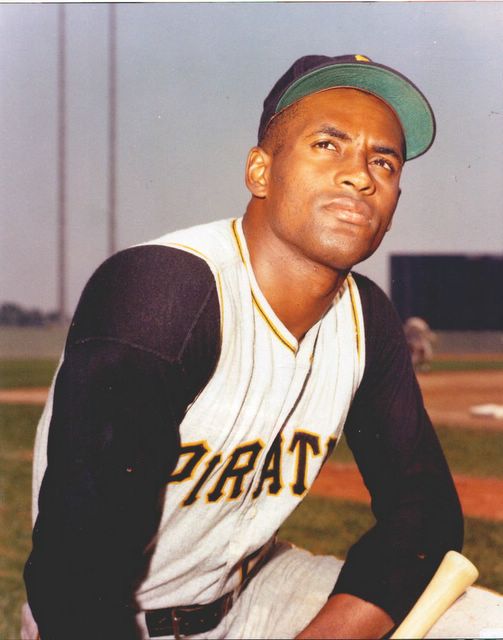
Roberto Clemente,60s hero Posted by Picasa
Enduring 60's Hero: Roberto Clemente

An article by Dave Maraniss in the Washington Post Sunday, taken from his book on Roberto Clemente that will be published later this month, is called The Last Hero. It was about Clemente as an enduring hero throughout Latin America. It's a very moving piece, not only for what it says Clemente continues to represent, some 34 years after his death, but what he had to endure as a Latino in major league baseball in the 1950s until 1972, when his small plane was lost as he tried to deliver relief supplies to earthquake victims in Nicaragua.

But even though I am not Latino, Roberto Clemente was a hero to me. He played his entire major league career for the Pittsburgh Pirates, and I grew up about 35 miles from the city. I saw him play at Forbes Field several times, watched the televised games and listened to many, many games on the radio, in the late 50s and early 60s.

MORE at Boomer Hall of Fame