Showing posts with label Climate Crisis. Show all posts
Thursday, May 05, 2011
Levels
This didn't make the headlines, not in bin Laden week--not that it would have anyway. But since it's a report to be delivered at a big international conference, maybe it still will. The report by Arctic Monitoring and Assessment Program says that the ice in the Arctic and Greenland is melting much faster than previously predicted, and is likely to result in a much greater rise in sea level this century: five feet. Some believe this is even too conservative an estimate, as it doesn't factor in other contributing causes to sea level rise. But it's a very significant rise.
There were a couple of thousand comments to this AP story. One said something to the effect that old age is looking better all the time. That's a common enough response. Another response was posted as a comment, but it has the look of an often-emailed piece that's made the rounds. Still, early boomers may be the last who recognize most of this from at least their childhood's:
" In the line at the store, the cashier told the older woman that plastic bags weren’t good for the environment. The woman apologized to her and explained, “We didn’t have the green thing back in my day.”
That’s right, they didn’t have the green thing in her day. Back then, they returned their milk bottles, Coke bottles and beer bottles to the store. The store sent them back to the plant to be washed and sterilized and refilled, using the same bottles over and over. So they really were recycled. But they didn’t have the green thing back her day.
In her day, they walked up stairs, because they didn’t have an escalator in every store and office building. They walked to the grocery store and didn’t climb into a 300-horsepower machine every time they had to go two blocks. But she’s right. They didn’t have the green thing in her day.
Back then, they washed the baby’s diapers because they didn’t have the throw-away kind. They dried clothes on a line, not in an energy gobbling machine burning up 220 volts – wind and solar power really
did dry the clothes. Kids got hand-me-down clothes from their brothers or sisters, not always brand-new clothing. But that old lady is right, they didn’t have the green thing back in her day.
Back then, they had one TV, or radio, in the house – not a TV in every room. And the TV had a small screen the size of a pizza dish, not a screen the size of the state of Montana . In the kitchen, they blended and stirred by hand because they didn’t have electric machines to do everything for you. When they packaged a fragile item to send in the mail, they used wadded up newspaper to cushion it, not styrofoam or plastic bubble wrap.
Back then, they didn’t fire up an engine and burn gasoline just to cut the lawn. They used a push mower that ran on human power. They exercised by working so they didn’t need to go to a health club to run on treadmills that operate on electricity. But she’s right, they didn’t have the green thing back then.
They drank from a fountain when they were thirsty, instead of using a cup or a plastic bottle every time they had a drink of water. They refilled pens with ink, instead of buying a new pen, and they replaced the razor blades in a razor instead of throwing away the whole razor just because the blade got dull. But they didn’t have the green thing back then.
Back then, people took the streetcar and kids rode their bikes to school or rode the school bus, instead of turning their moms into a 24-hour taxi service. They had one electrical outlet in a room, not an entire bank of sockets to power a dozen appliances. And they didn’t need a computerized gadget to receive a signal beamed from satellites 2,000 miles out in space in order to find the nearest pizza joint.
It’s a crying shame that we didn’t have “the green thing” back then! "
All of that is familiar to me. And while I remember that push mowers were no picnic, it does speak to a few things some of us have noticed: with greater prosperity and larger populations came greater complexity and much greater waste. Things were in some sense simpler and slower and less cluttered, though our choices were also fewer. English muffins were foreign food in the 50s, and you'd be considered weird if you wanted one.
So I think we know that losing a certain amount of "choice" however false and artificial is likely to be part of the price of survival in the future. The costs that have been ignored, and the costs that are unsustainably low (transportation of goods certainly) are going to be exacted on the future. But we're still here to say that a life that's more modest, more thoughtful and more sustainable, is possible. We had one.
Tuesday, April 19, 2011
For As Long As We've Got
Power Shift 2011 is a gathering of 10,000 or so mostly young people organizing for action to confront the Climate Crisis and related environmental crises. Leaders of the group met with President Obama, and the report of this at Climate Progress elicited the usual political grumbling and the inevitable debate on whether the Baby Boomers ruined everything. A bit unusual however was that it appeared boomers were taking both sides.
While one commenter wrote "my generation has failed, and too many of us have become indifferent or selfish." Another: "If there is to be a future,the youth of today are going to need to shame us grey hairs into making difficult decisions by staying in our faces forcing us to confront the truth. If our Youth are to have a life, then us Grey Hairs from Presidents & Legislators, Business Leaders & Faith Leaders, Opinion Makers & Everyday People need to be confronted with the facts that how we live in the present is consuming their ability to live in the future. It is encouraging to see our Youth refusing to let us steal their future."
But another commenter countered: " I think we deserve more credit than “failure”... That the fight took longer than any of us realized in the 60s and on does not mean we have failed. Look around. Civil Rights. Gay and lesbian rights. Women’s equality. Human rights around the world. Respect for the environment. And so much more. I agree none of the above is complete and can be considered a total victory but all are far from failure. The battle lines are getting closer to “Black” and “White” and that is why the rhetoric is sharper. Guns get drawn quickly. A cornered foe fights dirty. Big money spent hundreds of millions of dollars to control the power and the best they could muster is the Tea Party with an uninspiring IQ average. Yes, we have not won, but we are far from losers."
My own point of view is that while this also sounds like a dialogue within a single conscience, there is plenty of "failure" to go around. As much as I'm heartened by this organization and this conference, I've heard a little too much nonsense about "powerful" organizing techniques, and I'm afraid there's lots of evidence that artistic efforts and "messaging" haven't been very effective yet in furtherance of Power Shift's goals. That doesn't mean they should stop trying. It just doesn't make their efforts automatically superior, or the final answer.
And I also point out that the techniques these young people are using--including the theatre of large-scale demos--were pioneered by my generation during anti-war demos in the 60s and 70s. (Check out those puppets.)
While I regret many things in my life, I don't think I've regretted for a moment not going to one more demo. I did what I could, and I still do. All the good fight is a process, and we all have our parts to play in it. And if we follow the reference I'm pointing towards--Jacques' speech in As You Like It-- one determinant of our roles is age. We did what we could when we were young. I think we did a lot. Some of this "selfishness" later on was people concentrating on raising their families, seeing their kids through the tumults of the crazy 70s and depressing 80s, etc. And what we were part of did change things. And some of it backfired.
But now we're older, and some of us are old. We have perspective and specifics from our experience and history to contribute, if anybody cares to listen--and lumping us together with the people really responsible for "failure" isn't going to help with that.
And we can help with things like courage and perseverence and lasting. And that above all is what this is going to take.
Bill McKibben pretty much said so in his heartfelt and cogent address to Power Shift. He didn't mince words about the power that immense amounts of money has in this society right now. And he didn't mince words about our chances, or what it would take. He finished this way:
" So far, we’ve raised the temperature of the planet one degree and that’s done all that I’ve described, it’s melted the arctic, it’s changed the oceans. The climatologists tell us that unless we act with great speed and courage that one degree will be five degrees before this century is out. And if we do that, then the world that we leave behind will be a ruined world.
We fight not just for ourselves, we fight for the beauty of this place. For cool trout streams and deep spruce woods. For chilly fog rising off the Pacific and deep snow blanketing the mountains. We fight for all the creation that shares this planet with us. We don’t know half the species on Earth we’re wiping out.
And of course, we fight alongside our brothers and sisters around the world. You’ve seen the pictures as I talk: these are our comrades. Most of these people, as you see, come from places that have not caused this problem, and yet they’re willing to be in deep solidarity with us. That’s truly admirable and it puts a real moral burden on us. Never let anyone tell you, that environmentalism is something that rich, white people do. Most of the people that we work with around the world are poor and black and brown and Asian and young, because that’s what most of the world is made up of, and they care about the future as anyone else.
We have to fight, finally, without any guarantee that we are going to win. We have waited late to get started and our adversaries are strong and we do not know how this is going to come out. If you were a betting person, you might bet we were going to lose because so far that’s what happened, but that’s not a bet you’re allowed to make. The only thing that a morally awake person [can] do when the worst thing that’s ever happened is happening is try to change those odds.
I have spent most of my last few years in rooms around the world with great people, many of whom will be refugees before this century is out, some of whom may be dead from climate change before this century is out. No guarantee that we will win, but from them a complete guarantee that we will fight with everything we have. It is always an honor for me to be in those rooms. It is the greatest honor for me to be with you tonight. No guarantee that we will win, but we will fight side by side, as long as we’ve got."
So instead of fighting over who is responsible for failure, we pick each other up and we fight the good fight together. And if there is anything that getting older teaches you, it is the meaning of "[for] as long as we've got."
Thursday, April 22, 2010
The Quiet Crisis

Between last Earth Day and today--in fact, in March, during the final healthcare votes--Stewart Udall died. He was appointed by President Kennedy to serve as Secretary of Interior in 1961, and stayed under President Johnson until 1969, just before the first Earth Day. He was an environmental pioneer, part of the transition from conservation to environmental activism. The first environmental laws were passed, or were proposed (and passed soon after the first Earth Day, in the Nixon administration) on his watch.
Udall also wrote one of the pioneer books on the environment, though The Quiet Crisis is not much remembered. It followed by a year the first environmental classic and best-seller, Rachel Carson's Silent Spring. Udall's book took a more historical view, chronicling American conservation efforts. But crucially it also took a wider view, beyond chemical pollution to the total environmental effects of the growth-at-any-cost economy: "In a great surge toward 'progress,' our congestion increasingly has befouled water and air and growth has created new problems on every hand. Schools, housing, and roads are inadequate and ill-planned; noise and confusion have mounted with the rising tempo of technology; and as our cities have sprawled outward, new forms of abundance and new forms of blight have oftentimes marched hand in hand."
Although it preserves sign of hasty writing, The Quiet Crisis remains remarkable in the appropriate breadth of its content. He dealt not only with facts but the underlying and overarching philosophy. He elevated the work of Aldo Leopold and his "land ethic", now acknowledged as a central figure in even contemporary environmentalism, into public policy discussion. He went after examples of air, water and soil pollution--and assembled the first official endangered species list--but he also looked to the historical and spiritual sources that support and sustain attention to the natural world. He could be eloquent on this topic. "To pursue his vision more intently, Emerson steeped himself in Plato, Goethe, and fresh air. The easiest wayh to develop Olympian insights was to turn the mind into an aeolian harp and attune it to the winds and sounds and rhythms of nature."
In this book, he also dealt with urban environments as well as wilderness, with needed legislation and individual action. That the book has an introduction by President Kennedy shows that the environment was on the agenda almost a decade before Earth Day.
Stewart Udall was also one of the voices heard throughout this year's American Experience documentary, Earth Days. He was part of the mass movement before and just after Earth Day in 1970 that led to the laws that saved the United States--from erasing more wilderness, from poisoning more water, earth and air and therefore poisoning itself. But as this documentary notes, expanding effective environmental change to the world, and applying it to the most deadly threat human civilization has ever faced, climate change (which, the documentary documents, was talked about in a national news broadcast on the first Earth Day) has failed.
Udall called it the Quiet Crisis in 1963. It became pretty noisy on Earth Day 1970, when 2 million Americans participated, and soon after, when the fledgling movement targeted and defeated anti-environment legislators. But on its 40th anniversary, it has gone quiet again. There is still is no collective, focused action by environmentalists. Too much separate noise can also add up to a quiet crisis.
Thursday, December 17, 2009
The Wrong Enemy
The future has lots of enemies--greedy insurers, egomaniacal Senators, Climate Crisis deniers, petrified (in both senses) industrialists...so why on Earth would a someone want to invent a new one?
In this Worldchanging post, Alex Steffan declares that the war for the future is generational, young against old, apparently because of polls (which he doesn't bother citing) that say the older demographic believes in the Climate Crisis less than do the younger. The key graph:
"And this is what most older observers seem to refuse to understand: The world looks dramatically different if the year 2050 is one you’re likely to be alive to see. To younger people, Copenhagen isn’t some do-gooder meeting; it’s the first major battle in a war for the future. Their future."
It's not unusual for a younger generation to anoint itself the hope of the world, in opposition to the old people who have so far screwed things up. We did it in the 60s. Maybe with more justification, maybe with less. But it's like a lot of broad-brush categorical statements: even if it is in some sense true (and it is also always in some sense false) it alienates your potential allies within the group (older, male, white, etc.) you condemn.
Of course, scientists, writers, artists and even politicians in all of these categories are demonstrably in the forefront of the fight to address the Climate Crisis and to build a sustainable future. Some of them are from the 60s generation, like Al Gore, and others are even older, like the foremost climate scientists in England and the U.S. (James Hansen for one. James Lovelock, more radically that just about anyone, is in his nineties.) Steffan might be forgiven for youthful exuberance for ignoring this, except that later in his post he writes "if I were ten years younger" he would join the young "on the barricades."
Yes, in a statistical sense, there is a divide--older voters in the U.S. not only tend to be behind the curve on global heating, but on race, gender and social issues as well. Younger U.S. voters also tend to be more diverse racially and in other ways. But those are percentages, not numbers of people. And even the numbers aren't altogether relevant. There are millions on one side, and millions on the other.
What Steffans basically contends is at the heart of the difference--the dividing line that makes the older the enemy--is their relation to the future. The young will live to see it, and the old will not. Therefore, the young care more about the future.
There is some visceral truth to this idea. But only to a degree, and not enough to condemn the imaginations and commitments of older people. Older people are often parents and grandparents. Many older people do care about the future, partly because they are older. Past a certain age, older people are often less interested in the present than in the past and the future. They care about legacy, and about the planet that has borne their lives, and about their descendants, their grandchildren. There's hardly anything they care about more.
But speaking for my generation, many of us have made a lifetime commitment of caring about the future. And we have the scars to prove it. We were always a minority, even within our own generation. Just as you probably are within yours.
I doubt that every young person is worried about 2050. It takes imagination as well as motivation to think about the future, in any sense beyond the very narrow, and very short.
So my advice to Steffans and the others looking for enemies: you've got enough real ones, you don't need to invent--or create--new ones. The old are easy to scapegoat--the older, the easier. Yes, the biggest human barriers to change are usually older than 30. You have to be to be elected to the Senate, etc. Most of them are also right-handed. But then, maybe you are, too.
I echo Steffans' concern that the young will become discouraged and disheartened. Maybe older veterans of other fights can help with that.
In this Worldchanging post, Alex Steffan declares that the war for the future is generational, young against old, apparently because of polls (which he doesn't bother citing) that say the older demographic believes in the Climate Crisis less than do the younger. The key graph:
"And this is what most older observers seem to refuse to understand: The world looks dramatically different if the year 2050 is one you’re likely to be alive to see. To younger people, Copenhagen isn’t some do-gooder meeting; it’s the first major battle in a war for the future. Their future."
It's not unusual for a younger generation to anoint itself the hope of the world, in opposition to the old people who have so far screwed things up. We did it in the 60s. Maybe with more justification, maybe with less. But it's like a lot of broad-brush categorical statements: even if it is in some sense true (and it is also always in some sense false) it alienates your potential allies within the group (older, male, white, etc.) you condemn.
Of course, scientists, writers, artists and even politicians in all of these categories are demonstrably in the forefront of the fight to address the Climate Crisis and to build a sustainable future. Some of them are from the 60s generation, like Al Gore, and others are even older, like the foremost climate scientists in England and the U.S. (James Hansen for one. James Lovelock, more radically that just about anyone, is in his nineties.) Steffan might be forgiven for youthful exuberance for ignoring this, except that later in his post he writes "if I were ten years younger" he would join the young "on the barricades."
Yes, in a statistical sense, there is a divide--older voters in the U.S. not only tend to be behind the curve on global heating, but on race, gender and social issues as well. Younger U.S. voters also tend to be more diverse racially and in other ways. But those are percentages, not numbers of people. And even the numbers aren't altogether relevant. There are millions on one side, and millions on the other.
What Steffans basically contends is at the heart of the difference--the dividing line that makes the older the enemy--is their relation to the future. The young will live to see it, and the old will not. Therefore, the young care more about the future.
There is some visceral truth to this idea. But only to a degree, and not enough to condemn the imaginations and commitments of older people. Older people are often parents and grandparents. Many older people do care about the future, partly because they are older. Past a certain age, older people are often less interested in the present than in the past and the future. They care about legacy, and about the planet that has borne their lives, and about their descendants, their grandchildren. There's hardly anything they care about more.
But speaking for my generation, many of us have made a lifetime commitment of caring about the future. And we have the scars to prove it. We were always a minority, even within our own generation. Just as you probably are within yours.
I doubt that every young person is worried about 2050. It takes imagination as well as motivation to think about the future, in any sense beyond the very narrow, and very short.
So my advice to Steffans and the others looking for enemies: you've got enough real ones, you don't need to invent--or create--new ones. The old are easy to scapegoat--the older, the easier. Yes, the biggest human barriers to change are usually older than 30. You have to be to be elected to the Senate, etc. Most of them are also right-handed. But then, maybe you are, too.
I echo Steffans' concern that the young will become discouraged and disheartened. Maybe older veterans of other fights can help with that.
Wednesday, May 10, 2006
Butterflies Are Free No Longer
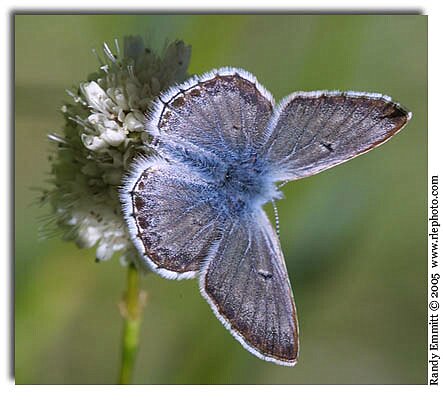
When I was a boy growing up in western Pennsylvania in the 1950s, just outside a small town, we had a neighboring field (known to adults as the "vacant lots") and several lots worth of trees across the street (which my mother called "the weeds.") So my childhood was filled with dandelions and violets, robins and cardinals, goldfinches, blue jays and bluebirds, and with butterflies. An enormous variety of butterflies--oranges, yellows, whites, blues, black and whites, all sizes and patterns.
I've never seen that profusion of butterflies again. The past few years here in far northern California, we've been blessed with some. Clusters of small white butterflies for awhile, and the occasional monarch-mimic orange and black patterned ones.
But this year, according to the San Francisco Chronicle, we may not see them. And possibly we may not see them ever again.
Wild fluctuations in California's winter and spring weather have hurt fragile butterfly populations, causing numbers to fall to the lowest in more than three decades and increasing the concerns of scientists about long-term declines linked to climate change and habitat loss.
UC Davis Professor Arthur Shapiro, considered one of the most prominent butterfly trackers in North America, said Monday he has found fewer butterflies this year than at anytime since he came to California 35 years ago. "We have a severe depression of butterfly numbers at the lower elevations in Northern California, particularly in the Central Valley. We don't know if local populations are extinct or have dropped to low levels that we're unlikely to detect,'' he said.
The very possibility of extinction is chilling. This is a dramatic illustration of one of the many complex effects of the Climate Crisis. Call it a cascade effect, call it a tear in the web of life, but global heating together with other phenomena, mostly due to human abuse of nature but some of it the ordinary cycles and variations, can have drastic consequences.
When I was a boy growing up in western Pennsylvania in the 1950s, just outside a small town, we had a neighboring field (known to adults as the "vacant lots") and several lots worth of trees across the street (which my mother called "the weeds.") So my childhood was filled with dandelions and violets, robins and cardinals, goldfinches, blue jays and bluebirds, and with butterflies. An enormous variety of butterflies--oranges, yellows, whites, blues, black and whites, all sizes and patterns.
I've never seen that profusion of butterflies again. The past few years here in far northern California, we've been blessed with some. Clusters of small white butterflies for awhile, and the occasional monarch-mimic orange and black patterned ones.
But this year, according to the San Francisco Chronicle, we may not see them. And possibly we may not see them ever again.
Wild fluctuations in California's winter and spring weather have hurt fragile butterfly populations, causing numbers to fall to the lowest in more than three decades and increasing the concerns of scientists about long-term declines linked to climate change and habitat loss.
UC Davis Professor Arthur Shapiro, considered one of the most prominent butterfly trackers in North America, said Monday he has found fewer butterflies this year than at anytime since he came to California 35 years ago. "We have a severe depression of butterfly numbers at the lower elevations in Northern California, particularly in the Central Valley. We don't know if local populations are extinct or have dropped to low levels that we're unlikely to detect,'' he said.
The very possibility of extinction is chilling. This is a dramatic illustration of one of the many complex effects of the Climate Crisis. Call it a cascade effect, call it a tear in the web of life, but global heating together with other phenomena, mostly due to human abuse of nature but some of it the ordinary cycles and variations, can have drastic consequences.
Subscribe to:
Comments (Atom)