Thursday, March 01, 2007

R.I.P.

Posted by Picasa
Arthur Schlesinger, Jr.

Arthur Schlesinger, Jr. was a respected biographer of FDR when he became an advisor to John F. Kennedy and then a special assistant to him in the White House. In the early 1960s, he transferred a phrase from Emerson to devise "The Politics of Hope" as a bold assertion that survives Camelot to still speak to some of us today.

He was a political player and theorist, judicious and penetrating. In the Kennedy years he showed that an intellectual could provide inspiration as well as guidance in politics, and as a writer he showed that intellectually substantive prose could also be popular. His 60s experience informed his subsequent writing on presidential power, and he also wrote one of the better books on the John F. Kennedy's presidency, and another on Robert Kennedy. He continued his incisive political commentary as recently as his 2004 book on the historic errors of the Bush administration. As an elder and an inspiration, I pay my respects to his memory.

His New York Times obituary is here.

Tuesday, February 06, 2007


The Pentagon 1968...who spit on who?
Posted by Picasa

Monday, February 05, 2007

Vietnam and the 60s: Phantoms and Realities

Dailykos the other day had prominent threads on two new books that concern the 1960s and Vietnam. One by devilstower was about The Spitting Image by Jerry Lembke, which debunks the media legend that protestors spit on returning Vietnam veterans. I have to confess that even I was taken in by this right wing smear. Emotions did run high, and I guess I could picture protests getting out of hand. Now I'm not sure what I remember versus what I saw in the movies about this. I know that there were protests at recruitment centers and draft boards. We protested ROTC and recruiters on campus (on our campus we did so by singing "Alice's Restaurant" at top volume.) But the image of protestors lined up at airports to dis returning soldiers comes not from history or reality but pernicious fiction.

I do clearly remember finding common cause with returning vets, and obviously many of them eventually became active, and became leaders, in the antiwar movement, just as Iraq vets are doing now. Even the young officer in charge of my group at my (first) draft physical closed the door at the end of it and told us that Vietnam was a crock and to stay out of it in any way we could. I also remember that protestors were spit on, as well as clubbed, gassed and punched.

As devilstower points out, the spitting on veterans lie was part of the attempt to spin the history to say that the U.S. lost Vietnam because of protestors, lack of support at home and the resulting lack of will by spineless politicians. It appears to be the argument that George Bush buys, and that informs his prosecution of Iraqnam.

The other frontpage post was by SusanG, about Jeff Kisseloff's Generation on Fire, an oral history told by 1960s activists. She also provided a link to Jeff's website , which will soon be a permanent link from this site. Susan (as usual) provides a thoughtful analysis of what she learned from these interviews (there are some on Jeff's site that aren't in the book) that pertains to progressives and activism today. I'm looking forward to exploring Jeff's site in detail and his book, but one thing is already clear: the "spitting" protestor is a phony phantam of the 60s, so it's about time to hear a little more of the reality.

Saturday, January 27, 2007


Protest in Washington, again. Photo: NY Times.
Posted by Picasa
A soldier's boots and a coffin symbolize the thousands of U.S. troops killed in Iraq, and the tens of thousands maimed. Photo: New York Times.
Posted by Picasa

Today in Washington

But soldiers aren't the only victims of this insane war. These shoes symbolize the tens of thousands--and perhaps hundreds of thousands--of civilians killed and maimed in Iraq since the U.S. invasion. New York Times photo.
Posted by Picasa
Again

“I grew up during the Vietnam War, but I never protested it and never had my lottery number called to go fight,” said David Quinly, a 54-year-old carpenter from Prairie Village, Kan., who arrived here Friday night with about 50 others after a 23-hour bus ride.“In my view, this one is a war of choice and a war for profit against a culture and people we don’t understand,” Mr. Quinly said. “I knew I had to speak up this time.”

That's from the New York Times report on today's antiwar demonstration in Washington, where "tens of thousands" of protestors focused on the Iraq war. From the podium, Susan Surandon said, according to the Times:

“We need to be talking not just about defunding the war but also about funding the vets,” Ms. Sarandon said, adding that more than 50,000 veterans had been injured while benefits for them continue to be cut.

The Washington Post has this quote:"When I served in the war, I thought I was serving honorably. Instead, I was sent to war ... for causes that have proved fraudulent," said Iraq war veteran Garett Reppenhagen.

Reuters reports that similiar demonstrations in Los Angeles and San Francisco today were attended by thousands.

Antiwar protests are all too familiar to baby boomers. On the plus size, many of us are still involved, still standing and marching. On the negative side, after Vietnam we perhaps did not significantly recognize that ending a war did not mean peace--that peace is a process requiring skills and attention. And of course, it was boomers who got us into this insane war. When will we ever learn.

Friday, January 12, 2007

Posted by Picasa

Thursday, January 11, 2007

Rebellion (and Why This is not the 1970s)

I'm not going to present a lot of tidbits with sources concerning the Bush plan for Iraq and the subsequent nearly unanimous disapproval, but some overall impressions. Even before antiwar protestors could begin mobilizing--and there are reports of demonstrations planned or accomplished in all fifty states--the reception given to the Bush plan, especially in the hearings featuring the new Defense Secretary and the old Sec. of State, Condi Rice, was nothing short of eviscerating.

Particularly striking were the Republicans and past Bush supporters, one of whom added that he not only was parting company with the Bushwar but was tired of being lied to. And he said this to Rice. While Senate GOP leader Mitch McConnell talked with the confidence of old about using a fillibuster to stop the attempt to pass a resolution of (essentially) no confidence in the President's plan, it soon appeared that there were already the 60+ votes to stop that, and vote on the resolution, which at the moment seems all but certain to pass.In other words, the Congress was in open rebellion. Tom Ricks of the Washington Post said on Charlie Rose that of all the armed forces officers who are either in Iraq or were, and who emailed him after the speech, not one thought the plan would work. The polls show overwhelming public skepticism if not outright opposition. And on and on.

There seem to be two main schools of thought about the why of this policy. The first is that Bush is sincerely messianic, and his reference to aggressive moves against Syria and Iran (which other administration figures minimized today) show a very dangerous intention to widen the conflict, perhaps to divert attention from Iraq, or simply to carry out a general attempt to impose American power in that part of the world.

The second possibility is that this is cover, a face-saving measure, for troop withdrawal by the end of the year, when the Iraqis and particularly the current government don't make good on their part of the bargain in the "pacification" of Baghdad.The closest historical precedent for both of these possibilities is ironically the same event: Nixon's invasion of Cambodia in 1970. Nixon both widened the war (as he would several more times) and claimed it was in order to facilitate the withdrawal of American troops.

The 1970s also offer the precedent of Congress cutting off funds for a war that the President wouldn't end, though it took another five years after Cambodia. This and more led Republican Senator Chuck Hagel to say that the President's speech represents the worst foreign policy catastrophe since Vietnam.There are plenty of other similarities, and we're likely to see more, like large scale protests. Keith Olbermann's charge in his special comment Thursday that Bush's approach is insane recalls the feeling that Nixon was nuts, and this was pre-Watergate. Firesign Theatre ran a fake candidate for president in 1972 (George Papoon) whose campaign slogan was "Not Insane."

But there are differences. One is the speed. Everything is accelerated--especially the response of establishment politicians. Only a handful of "radicals" in Congress were talking about Nixon the same way that virtually all members of the Senate Foreign Relations Committee talked about Bush today. No one in the news media was so openly, relentlessly and vociferously against the president's war as Keith Olbermann has been, or that Chris Matthews has become.This speed may be reflected in the likelihood that Congress is going to search for and perhaps find a way to cut off money to conduct this war.

There are other differences on policy that reflect the experience of Vietnam, and not only on the part of Vietnam vets like Chuck Hagel. But there is yet another difference that I find striking. That's the often repeated reason for opposition to this temporary surge or anything short of taking troops out of Iraq: it's not worth the lives of American soldiers. The idea that troops would be committed as a face-saving gesture leading to withdrawal that didn't damage American power or prestige as much as a "retreat" would have been perfectly acceptable to most Washington officials, media and academics.

It is not acceptable now, and that I believe is a consequence of antiwar activity in the Vietnam era, especially by those of my generation. This was something we stressed from the beginning, even though it would be John Kerry's testimony in 1971 or so that remains the most memorable formulation of that belief--how do you ask a soldier to be the last one to die for a mistake?

This is some progress, though not yet to the level of another of our contentions--that the war was immoral because of the death and destruction it brought to Vietnam and the Vietnamese people. There are very few voices these days outside the peace movement that make this point about Iraq and Iraqis.But these differences are not nothing. They are differences from the 1970s, caused in part by what we went through, and what we did, in the 1960s and 1970s.

Wednesday, November 22, 2006


Posted by Picasa

 Posted by Picasa

Thursday, October 26, 2006

Consensus Now

According to opinon polls, Republicans are losing voting groups like white men and Catholics which were keys to their success. They are falling further behind with women, and even losing 10% of the previously rock solid Christian right. But it is the older voter that politicos believed would swing this election.

Now Reuters in the New York Times says that older citizens are likely to vote based not on age-specific issues like Medicare drug benefits, but on the same issue that dominates this election for all other age groups: the war in Iraq.

Pollsters haven't seen such cross-generational agreement since 1992, when pocketbook issues dominated in all age groups and helped put Democrat Bill Clinton in the White House and his party in control of both houses of Congress.

For the sixties generation in particular, statements like Donald Rumfeld's today will sound familiar. Under reporters' questioning over the apparent discrepancy of statements made by the Iraq prime minister saying his country hadn't agreed to benchmarks, and the Administrations contention that it had, Rumsfeld said, You ought to just back off, take a look at it, relax, understand that it's complicated."

How many times were we told by the Lyndon Johnson administration and then the Nixon administration that only they had the information and ability to judge how things were going in Vietnam and what U.S. policy should be. Yet it was clear then and it became clearer later, that they had ignored the information and perspectives available to them from experts in the region, in the history of colonial wars and so on, as well as the observations of what was happening in Vietnam made by reporters and researchers.

This is even more clearly the case in Iraq. Every major mistake the Bush administration has made was predicted and those predictions appeared on television and in newspapers and magazines, most of them before the war was launched. Yet their arrogance continues.

Americans aren't buying it anymore. Including the 60s generation, and older.

Friday, September 22, 2006

Seems Like Old Times

Lately I've been catching myself making references that a dwindling number of people get. Like "Mr. Tooth Decay." I gather that Mr. Tooth Decay makes something of a comeback in kid circles from time to time, but the basic reference is to beloved old Colgate toothpaste commercials that ran on Howdy Doody, and you have to be way way old to remember those.

In a recent theatre review I mentioned that the only Latin phrase I remembered from school was from a cartoon in which a police officer has pulled over a driver and asks him "Ubi ignus est?" That people wouldn't understand the Latin was part of the joke, because I thought (as the creator of the cartoon did) that the context would suggest it. However, I hadn't realized that cops pulling over speeders and asking them, "Where's the fire?" is no longer a well-known cliche. (Nothing as pathetic as an unknown cliche, is there?) The editor actually looked up the Latin, got the phrase, then asked me what it all meant--could the cop have pulled over a firetruck? I cut the joke, pronto. (That means, right away. Cowboys used to say it in...well, never mind.)

But just when I was ready to put all that ancient history behind me, I read something like this in Dan Froomkin's Washington Post blog, and damn if 1968 doesn't come back as big as life:

On the dominant issue of our time, the president is in denial. By most reliable accounts, three and a half years into the U.S. occupation, Iraq is in chaos -- if not in a state of civil war, then awfully close. But President Bush insists it's not so. He says the people he talks to assure him that the press coverage about how bad things are in Iraq is not to be trusted.

You might think that the enormous gulf between Bush's perceptions and reality on such a life-and-death topic would be, well, newsworthy. But if members of the Washington press corps consider it news at all, apparently it's old news. They report Bush's assertions about Iraq without noting that his fundamental assessment of the situation is dramatically contradicted by the reporting from their own colleagues on the ground.

I call it Iraqnam, and this is why. We've already destroyed it in order to save it, and people keep dying and getting maimed in horrible ways there, because a lot of people have forgotten 40 years.

Saturday, September 02, 2006

William Sloane Coffin on Iraq

One of the major peace activists of the 1960s, William Sloane Coffin died this year. I just came across this statement (in the July issue of Soujourners) he made about the Bush War in Iraq:

"The war against Iraq is as disastrous as it is unnecessary; perhaps in terms of its wisdom, purpose and motives, the worst war in American history. Our military men and women were not called to defend America, but rather to attack Iraq. They were not called to die for America, but rather to kill for their country. What more unpatriotic thing could we have asked of our sons and daughters?"

Saturday, August 12, 2006


Paul, Mary and Peter of PP&M, who did one of the
popular versions of "Where Have All the Flowers Gone?"
in the early 1960s. Posted by Picasa

Friday, August 11, 2006

When Will We Ever Learn?

No more poignant a question was asked in the 1960s, when we were children. It was a refrain of "Where Have All the Flowers Gone?" that spoke specifically to concerns about the nuclear arms race and later Vietnam. But as we repeat the tragic blunders of Vietnam in stupifying detail, we experience again the resulting insanity at home, familiar from the 1960s. And for many older than us, from the 1950s as well.

First comes the imperial hubris.
Paul Krugman begins his analysis with Joe Lieberman: He has been wrong at every step of the march into the Iraq quagmire — all the while accusing anyone who disagreed with him of endangering national security. Again, on what planet would Mr. Lieberman be considered “sensible”? But I know the answer: on Planet Beltway. ...what’s really behind claims that Mr. Lieberman is sensible — and that those who voted against him aren’t? It’s the fact that many Washington insiders suffer from the same character flaw that caused Mr. Lieberman to lose Tuesday’s primary: an inability to admit mistakes.

They say: Pay no attention to the fact that I was wrong and the critics have been completely vindicated by events — I’m “sensible,” while those people are crazy extremists. And besides, criticizing any aspect of the war encourages the terrorists... I know that some commentators believe that anyone who thinks the Iraq war was a mistake is a flag-burning hippie who hates America. But if that’s true, about 60 percent of Americans hate America. The reality is that Ned Lamont and those who voted for him are, as The New York Times editorial page put it, “irate moderates,” whose views are in accord with those of most Americans and the vast majority of Democrats.

Lest we see this only as a generational failure, we should remember where Joe Lieberman came from. Fellow boomer Sid Blumenthal
reminds us:

When Lieberman ran his first primary campaign for the state senate in 1970, against an entrenched Democratic machine politician, he was an insurgent reformer, relying on an army of young idealistic volunteers. (One of them was Yale law student Bill Clinton.) Lieberman was a star liberal on the Yale campus, editor of the Yale Daily News, a civil rights worker in the south, an activist against the Vietnam war, and yet adept at getting out the vote.

Lieberman is a living cautionary tale as well in the demonization of those who question these imperial airs and actions. Shortly after his loss to Ned Lamont in the Connecuticut primary, and right after news broke about the terrorism plot foiled in England,
he said "I'm worried that too many people, both in politics and out, don't appreciate the seriousness of the threat to American security and the evil of the enemy that faces us -- more evil or as evil as Nazism and probably more dangerous than the Soviet communists we fought during the long Cold War," Lieberman said. "If we just pick up like Ned Lamont wants us to do, get out [of Iraq] by a date certain, it will be taken as a tremendous victory by the same people who wanted to blow up these planes in this plot hatched in England. It will strengthen them and they will strike again."

But he was hardly the only one piling up this amazing rhetoric. In just forty-eight hours time there was all this:

Vice President
Cheney said that the "purge" of Lieberman told "the al Qaeda types" that Americans don't have the will to defeat terrorists.

Right wing TV talker
Bill O’Reilly suggested that Lieberman’s defeat signalled to Iran that Americans "have no will to restrain their jihad.”

Right wing columnist
Cal Thomas refers to the "Taliban Democrats"

A CNN anchor suggested the Lamont might be considered "The al Qaeda Candidate"

All of this, plus President Bush tarring the biggest religion and major ethnic group in the world with the term "Muslim fascists," is all familiar from the persistent charge in the 60s that opposition to the Vietnam war was unpatriotic, giving aid and comfort to the Communist enemy. We soon learned this was akin to the McCarthyism and Blacklists of the 1950s.

If anything, the Bushite rhetoric is even harsher, but that might be related to a difference between now and then. In the 60s, many if not most Americans supported the President's conduct of the Vietnam war. Now however, some 60% of those polled in the U.S. say the Iraq war was not and is not worth it, while a
Zogby poll of Democrats show that 79% surveyed are glad that Ned Lamont won, and only 6% say their candidates should support the Iraq war. An AP poll shows Bush at his lowest approval level--33%--with Democrats favored over Republicans for Congress by 55% to 37%. Almost a fifth of Bush voters are defecting to the Democrats.

To be fair, Bush opponents are not rhetorically shy either, any more than antiwar advocates were in the 60s. But there's a difference when national leaders of the party in power go after opposition with such excess. Then it becomes the suppression of dissent, which we know was being done more than rhetorically in the 60s. What don't we know about what is happening now?

Sunday, August 06, 2006


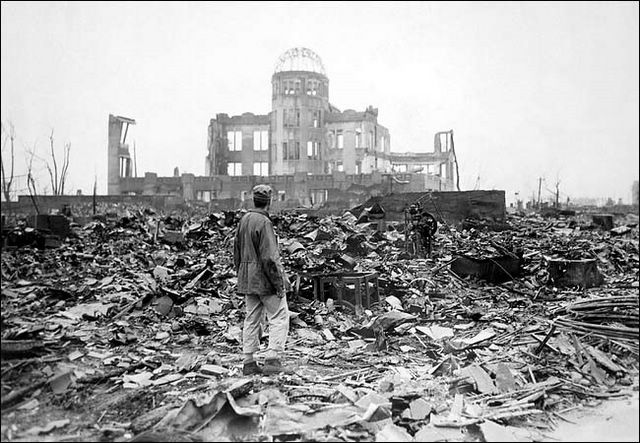
Hiroshima, August 1945 Posted by Picasa
After Hiroshima, Terrorism Is What Bombing Is For

On August 6, 1945, Hiroshima was destroyed by the first atomic bomb used in warfare. Three days later, President Truman began a pattern of lies that characterized the nuclear age.
But another lie also emerged from World War II, when the kind of bombing we see today--from the air, on urban centers and civilian populations--was first done regularly, on a large scale. The lie is that bombing is an effective, reasonable and legitimate method of waging war, whereas there are other despicable and illegitimate acts committed by uncivilized and ruthless enemies, called terrorism.

The truth is that bombing is terrorism, no matter who does it, and it always has been.

As Norman Solomon recently reminds us, the immense explosion at Hiroshima was followed by an immense lie. On August 9th, President Truman told the Amercan people: "The world will note that the first atomic bomb was dropped on Hiroshima, a military base. That was because we wished in this first attack to avoid, in so far as possible, the killing of civilians."

Solomon continues:

Actually, the U.S. government went out of its way to select Japanese cities of sufficient size to showcase the extent of the A-bomb's deadly power -- in Hiroshima on Aug. 6 and in Nagasaki on Aug. 9. As a result of those two bombings, hundreds of thousands of civilians died, immediately or eventually. If Truman's conscience had been clear, it's doubtful he would have felt compelled to engage in such a basic distortion at the dawn of the nuclear era.

In fact, Hiroshima had no military significance, and had not been bombed before--one of the principal reasons it was chosen for the A-bomb, so its destructive power would be more obvious to the Japanese and clearer for Americans studying those effects. It was considered a "safe city" to the extent that some parents in California who were forced into internment camps, sent their children to the safety of Hiroshima. So the victims of the U.S. atomic bomb likely included American children.

Truman's was the first of many lies of the nuclear era, including the initial lies about the effects of radiation. Some 75,000 people died in Hiroshima from the blast and fire of the Bomb. Five years later, radiation effects more than doubled the dead, to some 200,000. The vast majority of those who died from the Nagasaki bomb were from radiation, months and years later.
But the biggest lie is not about the atomic bomb, but the very practice of bombing. The facts show (as described in Sven Lindqvist's A History of Bombing and Gerard DeGroot's The Bomb: A Life, among other works) that the effect of bombing cities is not a strategy of war but a strategy of terror, and that it doesn't work.

The idea of this kind of bombing is not to kill enemy combatants or destroy military bases, but to destroy the population's will by terrorizing them with the threat of random death and destruction. Although the idea of this kind of bombing is now apparently acceptable, it is relatively new in the history of warfare.

While many nations experimented with it, especially imperial powers who bombed restless colonies, it was first used as a policy by the British in World War II in Germany. It did not result in a revolt of the German people against its government. The U.S. followed in its bombing campaign against Japan, at first aimed at military and industrial support targets, but eventually using saturation bombing against cities. It was the failure of this campaign to terrorize the Japanese population into submission that led to the decision to use the atomic bomb.

As Gerard DeGroot points out, when We (whoever We are) drop bombs, it is to destroy the enemy's capability to fight--the logic that says if you are going to destroy the enemy's tanks, then destroy the factories that build the tanks, and kill the people who work in those factories. But when They bomb Us, using the same logic, it is brutal, indiscriminate killing. "The difference is contrived--a matter of perspective. Indiscriminate bombing means killing civilians for the sake of attrition--the killing is the object."

But it isn't only attrition, and in less than the kind of total war that World War II was, it is more obviously aimed at terrorizing the enemy population. Hezbollah fires bombs into Israel to terrorize the population, hoping to eventually win concessions or ultimately to destroy the state of Israel. Israel fires bombs into Lebanon to destroy rocket implacements but also to terrorize the population into not supporting Hezbollah, either by allowing them to operate out of their neighborhoods or by supporting them politically. The strategy in both cases is the attrition of terror.

Argument on the morality of targeting civilians in war go back hundreds of years. All too ironically, the first known code that forbade the killing of non-combatants was promulgated by Abu Hanifa, a legal scholar in Baghdad. Western powers adopted a double standard: war between "civilized" European nations would be conducted in this civilized manner. But war against lesser peoples was total war, against the population as well as combatants. Primitive people were not only lesser, but more easily frightened by western technology's advances in explosives and methods of delivering them. World War II ended even these distinctions.

Now bombing is normal, and far from being the last resort, it is often the first option. Nations use it now because it is cheaper, and since no troops are endangered, there is no grumbling at home about the loss of life. Bombs of all kinds constitute a thriving business. In use, they have a very brief productive life before it's time to buy more. And there's plenty to chose from. Small groups can plant various kinds of bombs along roads or in parked vehicles, or use suicide bombers. Larger organizations can use bombs attached to small rockets. Nations can use bombs with sophisticated targetting capabilities, launched on rockets or fired from ships or dropped from airplanes. Long range missiles with thermonuclear weapons are still pointed at the U.S. and Russia.

From the smallest to the largest-yield weapons, bombs are instruments of terror. They sever the limbs of children, burn babies alive, destroy homes that send families into a tailspin of poverty, wreck the urban infrastructure that makes daily life possible, and send millions of traumatized people wandering into nightmare through the piles of broken homes and schools and hospitals, shards of bone, crushed bodies, smoldering flesh, hot twisted metal and clouds of toxic smoke, because they are supposed to. This is what bombs are for.

Friday, August 04, 2006


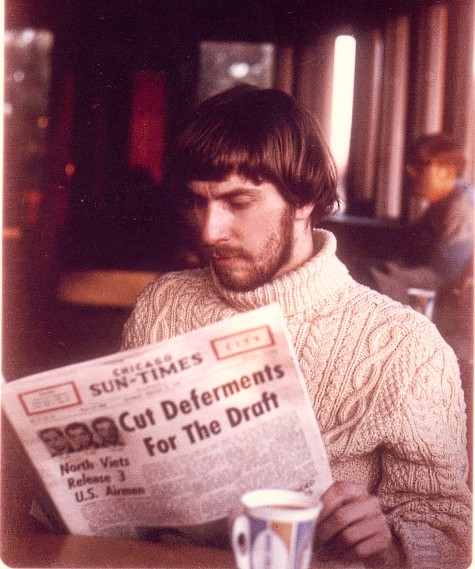
a fateful moment at the campus coffee shop.
photo by Bill Thompson. Posted by Picasa
Wars Within Wars

The Iraq war is becoming as long and agonizing as Vietnam--one poll says it is even more politically divisive. A Republican Senator said that the situation on the ground in Iraq is an "absolute replay" of Vietnam. A reporter who covered Vietnam sees a tragic repetition of the Vietnamization policy of the Nixon war, during which most Americans were killed and most of the destruction was done. And there are other resemblances as well.

Rather than make comparisons for you, let me simply tell a few stories about that time that seem relevant. These are recollections, with some poetic license, and like all stories, just one way of telling about it.

I obviously can't speak for everyone who was young in the Vietnam era. So when I say "we," it's shorthand for the people I knew. However, there were a lot like us. If you were draft age, and especially if you were in college, you were involved in these discussions to some degree.

Some of us talked about Vietnam and associated moral and political issues virtually every day. Some years (for me, the late 60s) there was hardly a conversation in which these subjects didn't come up.

There was one set of discussions about Vietnam: the politics, history and other contexts of the war. These began with the campus Teach-Ins in 1965 and became a major part of our education.

All of these discussions were in the context of a lot of information on campuses and in print--books, and extensive journalism, analysis and argument in the New York Review of Books, Ramparts and other publications. Many organizations sprang up and issued pamphlets, booklets and newsletters.

We listened to new young leaders and to established public figures, more and more of whom--from old Left firebrands and new poets to anthropologist Margaret Mead--were talking about the war and all the issues involved.

We also had novels (like Catch-22, Slaughterhouse Five) and poetry influencing the discussion. And especially music, that dealt with issues pretty directly (Dylan's "Masters of War" for example) or contributed in terms of spirit, and of suggesting alternative culture and ways of being.

There was a related set of discussions having to do with the morality of participating in an immoral war. It had to do with decisions that young men like me were being forced to make, because we were being drafted. For us, the discussions went beyond politics and academic discourse. We were trying to decide what we were going to do, because we were being forced to make a decision, about our lives, about life and possibly death.

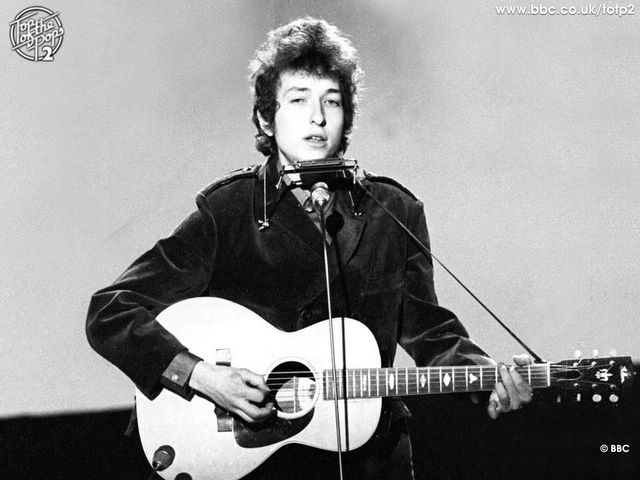
Bob Dylan Posted by Picasa
I turned 18 in the summer of 1964. I walked down the alley from the building where I was working, for the Voter Registration Drive sponsored by the Democratic Party and the local of the AFL-CIO's political committee, called COPE (I don't remember what the acronym stood for) to the draft board registration office. Actually, I hobbled. I was on crutches from catching a football as I was falling into a ditch. I don't recommend it as recreation.

I had the student deferment (2-S) during college, but we still had to report for physicals when called. I got called in 1967 during the highest draft call month of the war. My first physical was in Chicago, a chaotic nightmare of hundreds and probably thousands of young men in their underwear standing in lines and filling out forms.

We quickly learned that who passed and who didn't was almost entirely arbitrary, based on whether the person examining you at each station wanted you to get out or not. In my group, the top swimmer on our college team got out because somebody was a fan of college athletics. I was in the next line, and I was (and am) entirely deaf in one ear. I passed.

I also remember the young officer (a white guy) in charge of instructing us on filling out our forms. He was very authoritarian and by the book. Then when we were done he closed the door, and told us that anybody who went to Vietnam was a sucker, so get out any way you can.

Before that day and after, I consulted draft counselors in Chicago. There were several sets of them, from various organizations, and although they all gave you the information you needed about your rights, and the forms, etc. they each advocated a different approach to resistance. The Quakers advocated conscientious objector status. A more political organization preferred overt resistance, and jail as protest. However, by the time I was drafted, at least one of these groups changed their tactic. Draft protestors were singled out in prisons, they learned, and so they advised against going to jail if you had any other alternative, such as leaving the country (which generally meant Canada.)

March on the Pentagon 1967 Posted by Picasa
The moral questions we had to answer were many. They started with locating our beliefs about war. Am I against this war, or all wars? Under what conditions would I fight or kill?

Is it moral to avoid the draft when another will have to take your place? Is it moral to accept the draft and refuse to be a combatant, meaning another will take your place on the battlefield? On the other hand, is it moral to do anything, inside the Army or outside, that enables the war machine to continue?

For draft age men, there were practical questions that resulted from these quandaries. When I am called what should I do? Do I comply and hope for the best, hoping that either I don't get into combat situations or that I will make moral decisions if I do? Go into the army, and request a non-combatant role? But aren't non-combatants enabling others to kill, and isn't that equally immoral?

Do I resist and go to jail, and risk being in situations where I choose between being harmed and harming? Again, the issues of violence and nonviolent resistance.

Do I refuse by going to Canada, leaving behind everything and everyone I know?

To help answer these questions, we learned more. We learned more about how we would be trained, how the military worked, and how that would limit our choices once we were in it. We learned a little about what we could expect in prison. There was even less information on Canada, but we knew it meant we couldn't return, even if our families accepted our decision.

This makes it sound like a wholly rational procedure. It wasn't. It was nuts.

We saw a memo purporting to be a Selective Service document called "Channeling." It said that part of the purpose of the draft was to channel young men into activities that help the state--either in the armed services or into war work areas that were deferrable (weapons research perhaps), or if they were malcontents and protestors, channel them to jail or out of the country.

Those not faced with these imminent decisions debated the best ways to resist. Work within the electoral system--though there were few antiwar candidates? Was revolution the only answer? Analysis of the war led to analysis of reasons for the war, which led to moral issues involving racism, cultural as well as political imperialism, the military-industrial-academic state.

We spent a lot of time talking to each other about these issues, and trying to persuade other guys that fighting this war was wrong, that the army wasn't what they thought it was, and once they went in, they would regret it. These got to be passionate arguments, with a lot of angry words. Some women ended up in tears of frustration and sorrow for what these young men would be doing, and doing to themselves.

Besides the draft, there were also recruiters who came to campus, and we had ROTC on our campus as well. On the theory that reducing the number of people who go into the armed forces would reduce the ability to fight this immoral war, we protested recruitment on campus, and harassed recruiters when they showed up. We challenged them, as we challenged politicians, to start telling the truth. Because they were all lying, just about all the time.

There was no active protest against ROTC on my campus that I recall, but I do remember looking up from a newspaper I was reading in the student union to see a classmate in his ROTC uniform, and spontaneously giving him the Nazi salute. To me this was a bit of guerrilla theatre, something out of a Beatles movie even. But to him, as it turned out, it was very disturbing. We had a long talk about it on the patio outside the union building many months later, just before graduation. He told me his feelings about defending the country, and learning about honor and duty, and also about trading a couple of years in the Army for what they paid towards his college education. I told him my feelings about protesting the war and refusing as a patriotic act, and so on.

It was a sad conversation--especially since graduation was taking place at the same time as Bobby Kennedy's funeral-- but a real one. I'm glad we had it. A few weeks after graduation he was sent to Vietnam. He'd been there for two weeks when he was killed.

Buffy Sainte Marie Posted by Picasa
While months earlier, as I agonized over all this, I used every delaying tactic and bureaucratic opportunity I could to delay induction. By the time my induction physical was scheduled for Fort Des Moines, Iowa, I knew what I was going to do. First, I knew my rights down to the paragraph, and what appeals were due me. I had all my hearing tests and other information about possible physical disqualifications.

If all my efforts failed, I would refuse induction by stepping back when the oath was given. That would trigger more appeals. In the meantime, I had my conscientious objector papers ready to file. CO status was hard to get if you weren't a member of a church recognized as pacifist. I was raised Catholic, and the Crusades weren't a real good precedent.

But if I was going down, I would go down writing. I remember including the lyrics of a song called "Universal Soldier," written by Buffy Sainte Marie, but made popular by Donovan. It began:

He's five foot two, and he's six feet fourHe fights with missiles and with spears......He's the one who gives his body as a weapon in the war and without him all this killing can't go on...It ends:He's the universal soldier and he really is to blameHis orders come from far away no more/they come from himAnd you and me/and brothers can't you see/this is not the way we put the end to war.

I had come to the conclusion that it was a violation of my constitutional rights to be compelled to kill somebody. So I wrote that. I felt putting myself in position to be told to kill somebody, or to aid in killing people, without my informed consent, was immoral. I said that by pursuing an immoral war, the government and the army had ceded its moral authority.

But I had also come to the conclusion that personally I would not survive the army of these times. I was convinced that whatever I had that would be of use to the future would be destroyed in the army. It would drive me crazy in one way or another. (And in that I was sort of proved right.) Jail was the same kind of alternative. If I let them force me into one or the other, I figure they'd won. The war against the war was a guerilla war.

So if all else failed, I was going to head for the border. This was a big deal for me, because I had little conception of how I would survive. I've never been good at the making a living part of living, and I was really naïve then. My family was sympathetic about what I was going through, my parents didn't necessarily support the war (they had doubts) but they were frightened to death of the idea that I might refuse induction. And in any case, you soon learned that when you face these decisions, you really face them alone.

I took a long bus trip from Iowa City to Fort Des Moines, paid for by the Army. As I was the only member of my group on this trip, I was designated by the Army as the head of it. It was my first and last command.

I bunked at the barracks with a lot of farm boys pleased as punch to be going into the army and getting away from home, plus a few other college kids who found each other quickly and formed a squad for mutual self-protection. The army guys in charge pushed the kids around, but left us on our own.

My physical turned out to be a battle between the sergeant at station #1, regular army (black), who was thorough and flexible to the point that I was certain he was more than ready to let anybody who didn't want to be in the army just go home, and the doctor at station #9, a draftee (white) who eventually told me that no matter what I did or what my test results said, he was going to pass me, because if he had to do his two years, everybody did.

RFK campaigning in 1968 Posted by Picasa
This physical lasted three days. I had my hearing tests, and #1 sent me to a doctor in town for confirmation. With confirmation in hand I went to #9, who passed me. Same with other physical ailments. But I was getting the idea that #1 was going to let me string this out as long as necessary, so I began inventing things. I filed petitions based on the first ten amendments, separately, and on the UN Declaration of Human Rights. I wrote in rhyme wherever possible. I moved to the psychological claims.

As a kid from a working class culture I'd never even seen a psychiatrist up close before, but they sent me to a couple. After two and a half days of this, I was pretty convincingly crazy. I thought there was a film crew following me. To this day I don't know if it was a hallucination or not. Just before one of my appointments, I was facing a closed door. After twenty minutes or so, I saw the door open and a nurse come out of a broom closet, smiling at me. That's when I went in to see the shrink.

There was a different #9 that day and they wished me good riddance. They also told me that I'd never get a real job with this on my record. It took me a long time to recover from that period of time, the year or so from the first physical to the second, and I doubt I did completely. Between the two, Martin Luther King was killed, and the candidate I counted on to end the killing, Bobby Kennedy was killed. In the chaos of all this I couldn't take certain courses seriously and fell slightly short of my graduation requirements. Others of lesser academic standing had been given a waiver when they were that close. But as a well-known antiwar loudmouth, I was not.

I guess I've gone on so long about this to give you the context for what I'm about to say, which is the point of this diary. I did what I had to do to survive, body and soul. I did not survive unscathed. No one did. There were no moral certainties and though I'd been excessive at times in my criticism of those who became part of the war machine, I was ready to see things in a context which was in some ways larger, and in other ways, very specific.

I am not for a moment trying to say my experiences were equivalent to what soldiers went through in Vietnam. I was in a lot of protests, got into a few scrapes when total strangers could be violent because of your hair length, and caught my share of tear gas, but it's a whole different order from being under fire, in that context day after day, and coming home with those kinds of wounds. And for the record, I never spit at a returning soldier. Ever.

1967 at the 169 W. 1st St. Home for the Bewildered.
Is this a future Canadian MP? Posted by Picasa