Saturday, April 01, 2006


You're getting nowhere, are you, jeweler? Posted by Picasa

This Day in Boomer History

April Lennon Day


Not too surprisingly, April 1 and John Lennon met in the news on several occasions.

On April 1, 1970, John and Yoko announced they were both having sex change operations. No indication of how many reporters took them seriously before the April Fools Day joke was discovered.

In a different kind of foolishness, more classical in terms of the court jester tradition, John and Yoko announced on April 1, 1973, the formation of a new nation, which they called Nutopia. Nutopia had no laws and no borders. It's national anthem was silence.

There were two April 1s of a different nature involving John Lennon and his father, Freddie Lennon, who had abandoned his family when John was a baby. John and Freddie met again for the first time on April 1, 1964. They didn't see each other much after that. And on April 1, 1976, Freddie Lennon died.

Friday, March 31, 2006


There's something happening here...
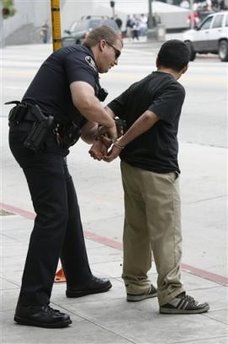
High school student protestor arrested in L.A. Posted by Picasa

1960s Now

New Protests in L.A.: "This is How They Did It in the 60s"

Antiwar demonstrations have become all too familiar since the 1960s, thanks to so many awful wars to demonstrate against. But the recent protests by Latinos against certain proposed legislation on immigration in the 2006 Congress have other direct roots to the 1960s: to the Civil Rights era, and to the Cesar Chavez marches and boycotts. In California, March 31 is a state holiday in honor of Chavez.

According to this article in the L.A. Times, high school students are looking to the 60s for some of their models for non-violent protest, in particular to Los Angeles school demonstrations in 1968 as depicted in the recently shown HBO film, "Walkout."

"It hearkens back to 1968," said Andres Jimenez, director of the California Policy Research Center at the University of California. "There was a sense of frustration that they saw with their parents in terms of the tenor of the immigration debate. This group is being singled out as a 'problem group.' And they wanted to seek an avenue to respond to that, to show that on the contrary, this group is very much a part of the broader society."

To be sure, students revealed both their youth and their naivete at times. When thousands of Los Angeles students descended on City Hall on Monday, for example, one student said she remembered something about civil rights protesters in the 1960s sitting down during demonstrations. It was a reference to the "sit-in," but it wasn't entirely clear whether the students recognized the pedigree of their decision to plop down on the steps.

"That was the idea of a girl from Belmont" High School, said Tabares. "In the '60s, the way they did it was sitting down. So we told everybody to sit down."

The story goes on to say that some students were also quite savvy about protesting, and had good instincts for how to be effective. They also use new tools, like the Internet, in particular Myspace.com, which became an information clearinghouse that every teenager knew but few adults did. The result in one school:

It didn't take long before most of Garden Grove High's roughly 2,200 students knew what was coming, without the knowledge or involvement of teachers or parents.

Soon, the bulletin crossed over an invisible but critical line between teens who were friends but attended different schools. Students began posting their telephone numbers, and soon dozens more pledges to participate were obtained through phone calls and instant text messages.

Still, when the tardy bell rang Monday morning, Muniz had no idea what to expect. Teenagers can talk a big game. But would they follow through?

She waited in front of the school. Soon, the doors opened, and scores of students — most of them Latino, but a handful of whites, African Americans and Asian Americans too — joined her. They marched through Garden Grove and Anaheim, picking up students at several other schools as planned through MySpace bulletins. By 1 p.m., they had covered 10 miles. An estimated 1,500 students had walked out. Muniz was a truant — and, to her friends, a hero.

Thursday, January 26, 2006

Intro to the Alpha version (work in progress)

As the battleship Missouri was sailing into Tokyo Bay to accept the Japanese surrender that ended World War II, my parents were walking up the aisle for their marriage ceremony at the Most Blessed Sacrament Cathedral. I was born the following June, as one of the first of the postwar baby boomers.

The baby boom generation, which demographers mark as beginning in 1946 and ending with babies born in 1964, was a major influence on institutions, culture, politics, business---just about everything. That influence was conspicuous from our infancy through childhood, early adulthood and maturity.

This year the first of us will turn 60. If life is a three-act play--with Act I as youth, and Act II as middle age, then early baby boomers are entering the last Act.

These days we often find ourselves vilified, both for our past and for the imagined costs to society of our projected dependence. Economically and culturally, we are increasingly isolated. Though we are in some ways still a huge market, and collectively we hold a lot of private wealth, we are no longer the obsessive target of advertisers, and therefore of the media supported by advertising.

That’s largely because advertisers don’t believe that can sway us anymore. Either because of our fixed habits or hard-earned skepticism or both, we can’t be so easily convinced to buy something or switch brands, after seeing a commercial that dramatizes how we will be instantly more attractive and successful if we do. We are kind of past a lot of that.

But that also means that news media are less likely to cover our concerns or activities. We may be the subject of cover stories this year, but there are few publications devoted to our interests.

This site—together with its companion site, The Boomer Hall of Fame --- is one small attempt to remedy that.

This site is about baby boomers and their interests and concerns, primarily for baby boomers, and by at least one baby boomer (though I hope many more will participate through comments.)